Tezcatlipoca (meaning "smoking mirror"[1]) is one of the creator deities in Aztec religion and the god of the night sky,[2] alongside many other symbols such as obsidian, hurricanes, war, and the earth. He is commonly represented with the smoking mirror for which he is named, alongside a missing leg[3] which was said to have been replaced by a mirror[2] or a serpent.[4]
Design
This design section is a stub. You can help Megami Tensei Wiki by expanding it.
No reason provided.
The appearance of Tezcatlipoca featuring alternating black-and-blue stripes in Devil Summoner: Soul Hackers is likely inspired by the mosiac mask of Tezcatlipoca, a cultural artifact representing Tezcatlipoca currently held in the British Museum. While uncertain, it is also possible that the yellow stripes on his skull from his design in Shin Megami Tensei II are inspired by an illustration of him in the Codex Borgia, which depicted him with a face consisting of three black stripes and two large yellow stripes separating them.
Origin: Mexico One of the Aztec creation deities. His name means "smoking mirror." Though he used to be a sun god, he is now the god of the night and the deceased. He has a destructive personality, but a strong sense of morality.
A fearsome creator god of Aztec lore. His name means "smoking mirror." A god of many things, including war, he was the first sun god before he was struck down by Quetzalcoatl.
A fearsome creator god of Aztec lore. His name means "smoking mirror." A god of many things, including war, he was the first sun god before he was struck down by Quetzalcoatl.
鏡が 好きな 戦士の 神 魔法つかいと 仲がよく イタズラ好きの 神でも あるTranslation: A warrior god who likes mirrors. It is good friends with magicians and is also the god of pranksters.
鏡が 好きな 戦士の 神 魔法つかいと 仲がよく イタズラ好きの 神でも あるTranslation: A warrior god who likes mirrors. It is good friends with magicians and is also the god of pranksters.
出身地:メキシコ 古代アステカの神話に登場する創造神で、その名は「煙る鏡」を意味していると言われる。テスカトリポカは「争い」「変化」を表す神であるともされる。彼はケツアルコアトル神によって地上に落とされた、原初の太陽神でもある。生命を与え、また自由に奪うことのできる能力を持った全知全能の神でもあり、テスカトリポカを祀る儀式では、この神の化身として一年を生きた若者を、儀式的に殺し、その心臓を捧げることによって祭事が成立していたと伝えられている。Translation: A creator god in Aztec mythology, a terrifying god also known as a demon king. He is also a god who presides over conflict and change.
Place of origin: Mexico A creator god who appears in the mythology of ancient Aztecs, his name is said to mean "smoking mirror". Tezcatlipoca is also considered a god who represents "conflict" and "change". He is also the primordial sun god, cast down to Earth by the god Quetzalcoatl. He is also an omniscient and omnipotent god with the ability to grant and take away life at will, and it is reported that in the rite worshiping Tezcatlipoca, a youth who has lived one year as an incarnation of the god would be ritualistically killed, and the ritual concluded by offering up their heart.
Nomenclature
Likely related to Classical Nahuatl: tezcatl ("mirror") and poctli ("smoke; fog; mist") or popoca ("to emit smoke").
↑"An outstanding symbol of this god is the "smoking mirror", which, in fact, gives him his name [...]" Myths of Pre-Columbian America (1978), Donald Alexander Mackenzie. Published by Longwood Press. p. 272. ISBN-13: 9780893413149.
↑ 2.02.1"One god of the nocturnal sky was Tezcatlipoca, or Lord of the Mirror Smoking, so called because of the black, magical mirror worn in place of a lost right foot." Night and Darkness in Ancient Mesoamerica (2021), David M. Reed, Nancy Gonlin. Published by University Press of Colorado. p. 21. ISBN-13: 9781646421879.
↑"The representation of Tezcatlipoca has a set of very similar iconographic features in most Mesoamerican cultures. They consist primarily of the "smoking mirror", the absence of one leg, and the characteristic breast-plate, among others." Tezcatlipoca: Trickster and Supreme Deity (2015), Juan José Batalla Rosado, edited by Elizabeth Baquedano. Published by University Press of Colorado. p. 41. ISBN-13: 9781607322887.
↑"Tezcatlipoca's standard iconography in Mexica manuscripts and relief sculpture includes a missing foot replaced by a smoking mirror or a serpentine form." Stone Trees Transplanted? Central Mexican Stelae of the Epiclassic and Early Postclassic and the Question of Maya ‘Influence’ (2014), Keith Jordan. Published by Archaeopress Publishing Limited. p. 43. ISBN-13: 9781784910112.


.jpg)


 English
 DemiKids Light Version and Dark Version
 Japanese


 Traditional Chinese
 Korean
 Artwork for Shin Megami Tensei from Shin Megami Tensei Hisshō Kōryaku-hō
 Artwork from Shin Megami Tensei II
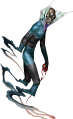 Artwork from Devil Summoner: Soul Hackers
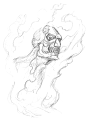 Concept artwork for Devil Summoner: Soul Hackers
 Artwork from Devil Children Light Book and Dark Book
 Render from Shin Megami Tensei: Liberation Dx2
 Sprite from the Super Famicom version of Shin Megami Tensei
 Sprite from the Mega-CD version of Shin Megami Tensei
 Sprite from the PlayStation version of Shin Megami Tensei
 Sprite from the PlayStation version of Shin Megami Tensei II
 Sprite from the PlayStation version of Shin Megami Tensei if...
 Sprite from Shin Megami Tensei IV
 Sprite from Last Bible III
 Sprite from Majin Tensei
 Sprite from Majin Tensei II: Spiral Nemesis
 Sprite from the PlayStation version of Devil Summoner: Soul Hackers
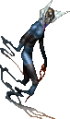 Sprite from the Nintendo 3DS version of Devil Summoner: Soul Hackers
 Sprite from Persona 2: Innocent Sin
 Sprite from Persona 2: Eternal Punishment
 Sprite from Devil Children Light Book and Dark Book and Devil Children Fire Book and Ice Book
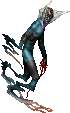 Sprite from Devil Survivor 2
 Sprite from Devil Survivor 2: Record Breaker
 Sprite from Shin Megami Tensei Trading Card: Card Summoner
 RTS icon from Shin Megami Tensei: Nine
 Icon from Devil Survivor 2
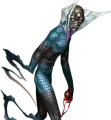 Graphic from Devil Survivor 2: Record Breaker
 Icon from Devil Survivor 2: Record Breaker
 Model from Shin Megami Tensei: Nine


