Qing dynasty illustration of Xi Wangmu from Chuugoku Koten Bungaku Taikei (Japanese, 中国古典文学大系)
Xi Wangmu,[a] known in English as the Queen Mother of the West, has origins in folk mythology, described in oracle bone script inscriptions dating back 3,300 years. The earliest, most ancient inscription describes giving her sacrifices for good fortune.[1]Huoniao are sometimes seen as her messengers.
The earliest elaborate literary account of Xi Wangmu can be found in the Classic of Mountains and Seas.[b] Here, she is a Chinese goddess associated with Mount Kunlun, distinct from the being of ancient folklore, said to live 1,300 li away in the Jade Mountain, amongst the Western Mountains.[2] She is said to have scraggly hair, the upper body of a woman, fangs of a tiger, the tail of a leopard, and the howl of a wild animal. Likewise, she rules over these beasts. She furthermore governs the Wu Can,[c] an evil star appearing in the east representing the death of ministers.[3]
Xi Wangmu was eventually adopted as a Daoist immortal,[d] being mentioned in Zhuangzi as having attained the 道 dào and ascended.[4] Her seat is among the highest in the pantheon, sitting on a western mountain, placing her in the same realm as Huang Di and Laozi. Xi Wangmu appears in this fashion in Journey to the West,[e] where she presents an orchard of Peaches of Immortality at a banquet in her Heavenly Garden in Yaochi[f] once every 3,000 years. However, at this specific one, her peaches were stolen and eaten by Sun Wukong[g] during his rebellion against heaven.
In folklore, Xi Wangmu is said to have had an intimate relationship with more than several individuals.[h][5] A particularly notable instance of this tale is mentioned in Records of the Grand Historian,[i] which tells of Mu of Zhou sending charioteer Sun Zaofu[j] on an imperial inspection tour. While on his trip, he met Xi Wangmu in the Kunlun Mountain. Zaofu, utterly smitten with her, forgot to return home.[6] As this was happening, a rebellion organised by Xu Yanwang[k] erupted within the Kingdom of Zhou. However, Zaofu, being a supremely talented chariot driver, managed to drive a thousand li in a day to quell the rebellion and save the kingdom. Thereafter, Mu bestowed upon Zaofu the family name Zhao.[l][7] Xi Wangmu's nature as a temptress led to the coining of the idiom 乐而忘归[m]lè ér wàng guī - to enjoy oneself and forget to go home.
Design
The design used for Xi Wangmu is based on her description in the Classic of Mountains and Seas, which itself states that she looks like but is distinct from the Queen Mother of the West of ancient legend.[5] Her fan bears the character 崑kūn, a component in the name 崑崙kūnlún for Mount Kunlun. Her headwear features the character 仙xiān, which refers to her status as an Immortal (Xiān) in Daoism.
An ancient Chinese goddess who ruled over the Kunlun mountains. She was worshipped during the Han Dynasty.
She looks like a human, but is said to have the teeth of a tiger and tail of a leopard. She kept the peaches of immortality, which Wu Kong stole and ate.
An ancient Chinese goddess who ruled over the Kunlun mountains. She was worshipped during the Han Dynasty.
She looks like a human, but is said to have the teeth of a tiger and tail of a leopard. She kept the peaches of immortality, which Wu Kong stole and ate.
An ancient Chinese goddess who ruled over the Kunlun mountains. She was worshipped during the Han Dynasty. She looks like a human, but is said to have the teeth of a tiger and tail of a leopard. She kept the peaches of immortality, which Wu Kong stole and ate.
An ancient Chinese goddess who ruled over the Kunlun mountains. She was worshiped during the Han Dynasty. She looks like a human, but is said to have the teeth of a tiger and tail of a leopard. She kept the peaches of immortality, which Wu Kong stole and ate.
An ancient Chinese goddess who ruled over the Kunlun mountains and was worshipped during the Han Dynasty. She may appear human, but is said to have the teeth of a tiger and tail of a leopard.
A goddess revered in ancient China who grew popular during the Han Dynasty. Her palace was said to be atop the mythological Mt. Kunlun.
She is mostly human in appearance, with a distinctive headdress, as well as the tail of a panther and the teeth of a tiger.
Originally she was said to govern the Five Calamities, but later came to be depicted as a beautiful sage and enshrined as the ruler of Mt. Kunlun.
Among her legendary encounters was Sun Wukong, who stole and ate the Peaches of Immortality.
↑Zhuang, Z. (2016). 庄子 [The Chuang Tzu] (Legge, J., Liu, J.H., & Wang, Y.J trans.). 1st ed. 中州古籍出版社 [Zhongzhou Ancient Books Publishing House]. Legge translation originally published in 1891.
↑ 5.05.1Sun, Jiankun. 2021. Fantastic Creatures of the Mountains and Seas: A Chinese Classic. First English-language edition. New York: Arcade Publishing.

 Revelations: Persona


 English
 Japanese


 Traditional Chinese
 Korean
 Artwork from Devil Summoner: Soul Hackers
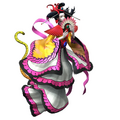 Render from Shin Megami Tensei: Liberation Dx2
 Sprite from Shin Megami Tensei IV
 Sprite from the PlayStation version of Devil Summoner: Soul Hackers
 Sprite from the Nintendo 3DS version of Devil Summoner: Soul Hackers
 Sprite from Megami Ibunroku Persona
 Sprite from Persona 2: Innocent Sin
 Sprite from Persona 2: Eternal Punishment
 Sprite from Devil Survivor 2: Record Breaker
 Sprite from Shin Megami Tensei Trading Card: Card Summoner
 Card graphic from Megami Ibunroku Persona
 Card graphic from Persona 2: Innocent Sin
 Card graphic from Persona 2: Eternal Punishment
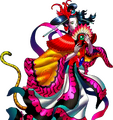 Graphic from Persona Q2: New Cinema Labyrinth
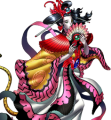 Graphic from Devil Survivor 2: Record Breaker
 Icon from Devil Survivor 2: Record Breaker
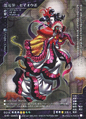 Card DS-089 from Shin Megami Tensei Card Game: Devil Summoner World


