Da Peng is a Demon in the Megami Tensei franchise.
Profile
Origin
The Dapeng[a] is a giant legendary bird allegedly mentioned in the Qi Xie,[b] by Zhuang Zhou[c] in his eponymous Daoist work Zhuangzi.[d] It allegedly lives in the Northern Ocean with an odd, almost absurd life cycle. Dapeng begins life as a Kun,[e] a type of fish, which will then transform into a roc bird-like creature called a Peng.[f] Zhuang Zhou quotes the Qi Xie as stating that when the Peng decides to move to the Southern Ocean, it flaps its wings over the water for 3,000 li, or around 1,500 miles, before rocketing up 90,000 li (~45,000 miles) to take flight, before resting at its destination for six months. It is later said to be of several li in breadth, with quills the height of Mt. Tai, and wings like clouds. The story surrounding Dapeng is a parable: A small dove, a cicada, and a quail all laugh at the extreme effort it goes through for its life cycle, but do not comprehend its magnitude nor its full lifestyle.[1] The parable has prompted a famous idiom: 鲲鹏展翅 Kūnpéng zhǎnchì; "the Peng spreads its wings and begins to fly," used figuratively to imply a display of immense power.[2]
The Qi Xie text itself has never been found and is not mentioned in Classical Chinese bibliographies or catalogues. It is thought by some to be a pseudo-citation; the book's name, character-for-character, means 齐 "harmony" and 谐 "jest", literally translating to "Harmonious Tall Tales". It could, therefore, be a mockery of Confucian philosophy, aimed at opening the reader's mind to uncertainty given its position at the start of the text and later satire of Confucian philosophers.
Peng was invoked as a moral lesson in the Ming dynasty text Youxue Qionglin to encourage the low to know their place, describing a lowly, critical official representing the quail laughing at Peng: Here, Peng represents unattainable grandeur.[3] Also in the Ming dynasty, Peng is featured in The Celebration at the Water Palace,[g] where multiple flank the Sea God King Guang Li,[h] who was sailing with the scholar Yu Shanwen[i] after he had produced an excellent prayer for inaugurating the King's main beam of his new Palace of Divine Virtue.[4]
Design
The Da Peng seen in Megami Tensei is a combination of Kun and Peng, representing the common 鲲鹏 Kūnpéng disyllabic name used to refer to it today. Thus, it has the fish elements of Kun, and the roc elements of Peng.[2]
Gameplay
|
|
| Name
|
Level
|
HP
|
MP
|
| Da Peng
|
47
|
296
|
155Sega Saturn/175PlayStation Portable
|
|
|
|
|
| Species
|
Race
|
Alignment
|
Size
|
Recruit
|
Speech
|
RERandom Encounter
|
| Avian
|
Flight
|
Neutral-Law (87)
|
M
|
≠Sometimes
|
Beast (Higher)
|
✔
|
|
| Attack
|
Accuracy
|
Defense
|
Evasion
|
M. Atk
|
M. Def
|
Drop
|
| 122
|
92
|
112
|
90
|
23
|
36Sega Saturn/37PlayStation Portable
|
 Chakra Chip Chakra Chip
|
|
|
|
| Moon Phase Damage Output
|
 New New
|
 1/8 1/8
|
 2/8 2/8
|
 3/8 3/8
|
 Half Half
|
 5/8 5/8
|
 6/8 6/8
|
 7/8 7/8
|
 Full Full
|
| 100% |
100% |
100% |
100% |
100% |
100% |
100% |
100% |
100%
|
|
| Basic Attack
|
Element
|
Hit(s)
|
Target
|
Range
|
| Demon Attack
|
1-2
|
Single enemy
|
Front row
|
|
| Magic Skills
|
| Skill
|
Attribute
|
Cost
|
Description
|
 Media Media
|
Recovery
|
6 MP
|
Recovery magic. All. Recovers just a little HP to all allies.
|
|
| Extra Skills
|
| Skill
|
Attribute
|
Cost
|
Description
|
 Wing Flap Wing Flap
|
Skill
|
4% HP
|
Special physical action. Power 6. All attack.
|
| Panic Voice
|
Mind
|
12 MP
|
Special magic action. All. Bad status. Panic effect to all enemies.
|
|
|
|
| Name
|
Level
|
HP
|
MP
|
| Da Peng
|
47
|
296
|
155Sega Saturn/175PlayStation Portable
|
|
|
|
|
| Species
|
Race
|
Alignment
|
S. CostCOMP Summoning Cost
|
C. CostCompendium Summoning Cost; PSP only
|
CPMagnetite used
|
| Avian
|
Flight
|
Neutral-Law (87)
|
470 MMagnetite
|
12800 MMagnetite
|
42
|
|
|
|
| Attack
|
Accuracy
|
Defense
|
Evasion
|
M. Atk
|
M. Def
|
| 122
|
92
|
112
|
90
|
23
|
36Sega Saturn/37PlayStation Portable
|
|
|
|
| Moon Phase Damage Output
|
| New
|
1/8
|
2/8
|
3/8
|
Half
|
5/8
|
6/8
|
7/8
|
Full
|
| 100% |
100% |
100% |
100% |
100% |
100% |
100% |
100% |
100%
|
|
| Basic Attack
|
Element
|
Hit(s)
|
Target
|
Range
|
| Demon Attack
|
1-2
|
Single enemy
|
Front row
|
|
| Magic Skills
|
| Skill
|
Attribute
|
Cost
|
Description
|
| Media
|
Recovery
|
6 MP
|
Recovery magic. All. Recovers just a little HP to all allies.
|
|
| Extra Skills
|
| Skill
|
Attribute
|
Cost
|
Description
|
| Wing Flap
|
Skill
|
4% HP
|
Special physical action. Power 6. All attack.
|
| Panic Voice
|
Mind
|
12 MP
|
Special magic action. All. Bad status. Panic effect to all enemies.
|
|
Compendium

|
This section has content in need of translation.
|
| The content in this section is missing a translation. You can help Megami Tensei Wiki by adding one.
|
| Compendium Entries
|
| Shin Megami Tensei: Strange Journey
|
A giant bird of Chinese lore.
They are so huge that it is impossible to tell their actual size. They can fly 30,000 miles into the sky, and their wingspan is as long as the clouds.
|
| Shin Megami Tensei IV
|
A giant bird of Chinese lore.
They are so huge that it is impossible to tell their actual size. They can fly 30,000 miles into the sky, and their wingspan is as long as the clouds.
|
| Shin Megami Tensei IV: Apocalypse
|
A giant bird of Chinese lore.
They are so huge that it is impossible to tell their actual size. They can fly 30,000 miles into the sky, and their wingspan is as long as the clouds.
|
| Shin Megami Tensei: Devil Summoner(Akuma Zensho; PSP)
|
出身地:中国
中国の伝説上の巨鳥。漢字では「大鵬」、あるいは「大鳳」である。
「荘子」に登場するこのタイホウは、何千キロメートルあるか分からないほどの体長があると伝えられる。もとは北方の海に棲む鯤(こん)という巨大な魚で、これが化けてタイホウになる。
9万里、すなわち3600キロほどの上空を飛んでおり、大空いっぱいに広げた翼は、雲のように空を覆う。Translation: Place of origin:
|
| Devil Summoner: Soul Hackers(3DS)
|
A giant bird of Chinese lore.
They are so huge that it is impossible to tell their actual size. They can fly 30,000 miles into the sky, and their wingspan is as long as the clouds.
|
| Devil Survivor 2
|
A giant bird of Chinese lore.
They are so huge that it is impossible to tell their actual size. They can fly 30,000 miles into the sky, and their wingspan is as long as the clouds.
|
| Devil Survivor 2: Record Breaker
|
| Kētai Akuma Densho
|
中国の伝説に伝えられる巨鳥。鯤と呼ばれる巨大な魚が変化し、鳥となったものと言われる。
出身地:中国
タイホウはもともと荘子の「消揺遊篇」に登場した巨大な鳥で、その後「西遊記」「封神演義」といった小説にも登場した。その記述によると、タイホウは北極のさらに北にある天の池に棲む鯤(こん)と呼ばれる大きさが数千里もある巨大な魚が、変化したものだと言う。タイホウは、神々の存在するはるか古代より存在していると言われており、海が荒れ狂う時になると、南の海を目指して飛び立つと言われている。
Translation: A giant bird passed down in Chinese legend. It is said to be the bird that the giant fish known as Kun transforms into.
Place of origin: China
Da Peng originally appeared in the "Carefree Wandering" chapter of the Zhuangzi as a giant bird, and later appeared in the novels Journey to the West and the Investiture of the Gods. According to their descriptions, Da Peng is what the fish several thousand li in size, called Kun, which resides in the Lake of Heaven to the north of the North Pole, is said to transform into. Da Peng is said to have existed long ago, long before the gods existed, and it is said that when the sea rages, it takes off flying towards the southern sea.
|
Nomenclature
Names in Other Languages
| Language |
Name |
Meaning
|
 English English
|
Da Peng
|
 Japanese Japanese
|
タイホウ Taihō |
Japanese pronunciation of the Chinese characters 大鵬 (dapéng).
|
Gallery
-
-
-
-
Sprite from the
Sega Saturn version of
Shin Megami Tensei: Devil Summoner
-
-
Sprite from the
Nintendo 3DS version of
Devil Summoner: Soul Hackers
-
-
-
-
Icon from Devil Survivor 2
-
Graphic from Devil Survivor 2: Record Breaker
-
Icon from Devil Survivor 2: Record Breaker
Notes
- ↑ Simplified Chinese: 大鹏, Traditional Chinese: 大鵬, romanized Dà Péng
- ↑ Simplified Chinese: 齐谐, Traditional Chinese: 齊諧, romanized Qí Xié
- ↑ Simplified Chinese: 庄周, Traditional Chinese: 莊周, romanized Zhuāng Zhōu, also known as Master Zhuang 庄/莊子 Zhuāng Zǐ.
- ↑ Simplified Chinese: 庄子, Traditional Chinese: 莊字, romanized Zhuāngzǐ
- ↑ Simplified Chinese: 鲲, Traditional Chinese: 鯤, romanized Kūn
- ↑ Simplified Chinese: 鹏, Traditional Chinese: 鵬, romanized Péng
- ↑ Simplified Chinese: 水宫庆会录, Traditional Chinese: 水宮慶會錄, romanized Shuǐ gōng qìng huì lù
- ↑ Simplified Chinese: 广利王, Traditional Chinese: 廣利王, romanized guǎng Lì Wáng
- ↑ Chinese: 余善文, romanized Yú Shànwén
References
- ↑ Zhuang, Z. (2016). 庄子 [The Chuang Tzu] (Legge, J., Liu, J.H., & Wang, Y.J trans.). 1st ed. 中州古籍出版社 [Zhongzhou Ancient Books Publishing House]. Legge translation originally published in 1891. Available on ctext at: https://ctext.org/zhuangzi/enjoyment-in-untroubled-ease/ens
- ↑ 2.0 2.1 黄成兰 [Huang Chenglan]. 二零一七年 [2017]. 汉语成语词典 [Chinese Chenyu Dictionary]. 全新版 [New Revised Edition]. 成都: 四川辞书出版社 [Chengdu: Sichuan Cishu Chuban She]., Pleco Software. (2025). Pleco Basic Chinese-English Dictionary based on A Chinese-English Dictionary (Version 3.2.98) [Mobile App]. 2009. Foreign Language Teaching & Research Press. Pleco Inc. https://www.pleco.com.
- ↑ Cheng, D.J. et al. (2023). 幼学琼林 [Yòuxué Qiónglín] in 幼学琼林三百千 [Yòuxué Qiónglín Sānbǎiqiān]. 万卷出版社 [Wanjuan Publishing House]. Quote: 贱反轻贵,似鸴鸠反笑大鹏。
- ↑ Qu, You. (2024). 剪燈新話 [New Stories Told While Trimming the Wick] (Zhang, Z.Z., Sondergard, S.l., and McKay, T. Transl.). Oxford University Press. ISBN: 978-0-19-766877-1.


 Artwork from Shin Megami Tensei: Devil Summoner
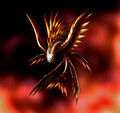 Render from Shin Megami Tensei: Devil Summoner: Akuma Zensho
 Sprite from Shin Megami Tensei IV
 Sprite from the Sega Saturn version of Shin Megami Tensei: Devil Summoner
 Sprite from the PlayStation version of Devil Summoner: Soul Hackers
 Sprite from the Nintendo 3DS version of Devil Summoner: Soul Hackers
 Sprite from Devil Survivor 2
 Sprite from Devil Survivor 2: Record Breaker
 Sprite from Shin Megami Tensei Trading Card: Card Summoner
 Icon from Devil Survivor 2
 Graphic from Devil Survivor 2: Record Breaker
 Icon from Devil Survivor 2: Record Breaker


