Huoniao[a] is another name for the three-legged crow[b] mentioned in the Classic of Mountains and Seas, beings living in suns, where their rays concentrate north of Mo Chi. They resided in the Fusang, China's ancient world tree, and would be sent off to fly around the world one by one by the solar goddess Xihe. Their rays concentrated most strongly in Mo Chi.[1] They fed on grasses of immortality, but due to overfeeding, their eyes were covered by Xihe.[1] The legend dates back to Neolithic China.
Ancient sources tell that China once had 10 three-legged crows, which ended up congregating and scorching the earth due to their sheer heat. The archer Hou Yi begged the Jade Emperor to make it stop, but to no avail. Unable to reason with the deities, he shot down the suns one by one, revealing the three-legged crows inside. After shooting down nine, still angry at the situation, Hou Yi was about to shoot the final sun, but Emperor Yao and the solar goddess Xihe pleaded with him to stop. Realising that the world still needed a sun, he relented.
The three-legged crow is associated with Xi Wangmu, being thought of as her messengers.
The name Huoniao is sometimes used as a synonym for the Fenghuang, though it does not have three feet, nor is it associated with these legends.
Design
Huoniao's lantern has the Chinese character 凶 on it, meaning "bad omen". Unlike canon legend, Huoniao is not depicted as gold.
In ancient China, there used to be 10 suns which would take turns travelling the sky. But one day, all ten sun appeared in the sky and scorched the earth. A man named Hou Yi shot down nine of the suns.
In ancient China, there used to be ten suns which would take turns traveling the sky. But one day, all ten suns appeared in the sky and scorched the earth. A man named Hou Yi shot down nine of the suns.
A three-legged bird said to live in the sun. In ancient China, there used to be ten suns which would take turns traveling the sky. But one day, all ten suns appeared in the sky and scorched the earth. A man named Hou Yi shot down nine of the suns.
A three-legged bird said to live in the sun.
In ancient China, there used to be ten suns, which would take turns travelling the sky. But one day, all ten appeared in the sky and scorched the earth. A man named Hou Yi shot down nine of the suns, but those were actually the Huoniao that lived in the suns. And so there is only one sun left, but the remnants of when there used to be ten can still be seen in the 10 Heavenly Stems of the 12 Earthly Branches.
Ancient Chinese legend has it that once there were ten suns that rode across the sky, each in succession. One day, all ten appeared at once, bringing flame to sear sky and earth alike.
A hero named Hou Yi raised his bow to shoot down nine of the suns, sparing humanity and the earth.
It was said that a three-legged Kau lived within each of the suns. Now, only one travels across the sky, bringing light to the world. It's fires burn strong enough to warm, but not to sear and scar.
出身地:中国 太古の中国には10個の太陽があり、1個づつ順に天空を旅していた。しかしある時10個の太陽が一度に空に現れ、地上は灼熱の焦土となった。これをゲイという男が9個まで射落とした。彼が射たのは太陽に棲むカウに他ならなかった。太陽は1つとなったが、10個であった頃の名残りは、十干十二支の十干や10日を1旬とする暦法にみることができる。Translation: A crow said to live in the sun. It has three legs. 火烏 ("fire crow") in Chinese characters.
Place of origin: China In ancient China, there were 10 suns, each traveling the sky 1 at a time in order. However, on one occasion, the 10 suns appeared in the sky all at once, and the surface of the earth became a red-hot scorched land. Then, a man named Yi shot down 9 of them. Those he shot were none other than Huowu inhabiting suns. There was now 1 sun, but the remnants of the 10 that used to exist can be seen in the 10-day calendar cycle constituting a Xun and the Ten Heavenly Stems of the Ten Heavenly Stems and Twelve Earthly Branches.
Nomenclature
The name "Huoniao" is derived from the Chinese 火鳥huǒ niǎo (lit. "fire bird") while the name "Kau" is derived from the visually similar 火烏huǒ wū (lit. "fire crow").

.jpg)


 English
 Shin Megami Tensei: Strange Journey
 Japanese
 Korean
 Artwork from Shin Megami Tensei: Devil Summoner
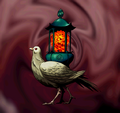 Render from Shin Megami Tensei: Devil Summoner: Akuma Zensho
 Sprite from Shin Megami Tensei IV
 Sprite from the Sega Saturn version of Shin Megami Tensei: Devil Summoner
 Sprite from Persona 2: Eternal Punishment
 Sprite from Devil Survivor: Overclocked
 Sprite from Devil Survivor 2: Record Breaker
 Sprite from Shin Megami Tensei Trading Card: Card Summoner
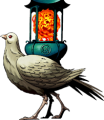 Graphic from Devil Survivor: Overclocked
 Icon from Devil Survivor: Overclocked
 Graphic from Devil Survivor 2: Record Breaker
 Icon from Devil Survivor 2: Record Breaker


