Dual-bodied Shōten (Kangiten), from the Butsuzōzui (1690)
Kangiten, also known as Shōten, is the Japanese Buddhist form of the Hindu deity Ganesha, who is identified in Buddhist texts as Vinayaka or Ganapati. The figure ultimately derives from Indian mythology, where Ganesha is associated with obstacles, wisdom, and prosperity. In early Buddhist tradition, however, Vinayaka was originally regarded as a malevolent being or demon responsible for creating obstacles, before later being reinterpreted as a protective deity.
According to Buddhist legend, Vinayaka was subdued and converted through the intervention of a benevolent counterpart associated with Avalokiteshvara (Kannon), who pacified him and transformed him into a force for good. This transformation is symbolized in the Japanese depiction of Kangiten as a dual-bodied, embracing male and female pair, representing the union of opposing forces and the deity’s conversion from a destructive to a benevolent figure.
Kangiten was introduced to Japan through esoteric Buddhism during the 8th–9th centuries and became particularly prominent in the Heian period. Over time, he came to be worshiped as a deity of joy, prosperity, and marital harmony, while still retaining associations with the removal or control of obstacles.
Design
This design section is a stub. You can help Megami Tensei Wiki by expanding it.
They abolish evil, bring harmony to couples and cause conceivements. They are commonly depicted as a male and female with elephant heads embracing each other. It was formerly a violent god whose worship required strict conduct.
They abolish evil, bring harmony to couples and cause conceivements. They are commonly depicted as a male and female with elephant heads embracing each other. It was formerly a violent god whose worship required strict conduct.
Ganesha's form in his Buddhist aspect. They abolish evil, bring harmony to couples and cause conceivements. They are commonly depicted as a male and female with elephant heads embracing each other. It was formerly a violent god whose worship required strict conduct.
Ganesha's form in his Buddhist aspect. They abolish evil, bring harmony to couples, and cause conceptions. They are commonly depicted as a male and female with elephant heads embracing each other. It was formerly a violent god whose worship required strict conduct.
A form of Ganesha adopted into Buddhism. It is said to bring many benefits.
Kangiten is commonly portrayed as a man and woman with elephant heads hugging each other. The male is said to be the son of Shiva and the female, recognizable as the one stepping on the other's foot, to be Guanyin. It is a violent god and its followers are required to follow strict rules.
出身地:インド カンギテンは、インドの古代神話に登場するシヴァ神の子・ガネーシャが仏教に取り込まれて成った神で、災いを除き、男女の和合や子授けの御利益があると言われている。一般的には象の頭をした男女が抱き合う姿で表される。男天は大自在天であるシヴァ神の子で大暴神であり女天は十一面観音が化身した姿であるとされる。相手の足の指を踏み押さえている方が女天であると言う。もともとが荒々しい神であるため、その信仰者には厳格な行を求めると言われる。Translation: A god resulting from the incorporation of Ganesha, the son of Shiva in Indian mythology, into Buddhism. Believed to bring many blessings.
Place of origin: India Kangiten is the god who resulted from the incorporation of Ganesha, a child of Shiva appearing in ancient Indian mythology, into Buddhism, and it is said to eliminate disasters, bring blessings of harmony between men and women, and answer prayers for conception. It is generally portrayed as a man and woman with elephant heads embracing each other. The male god is considered to be an incarnation of Shiva's son Daijizaiten (Maheshvara), a violent god, while the female god is considered to be an incarnation of Jūichimen Kannon (Eleven-Faced Avalokiteshvara). The one who is stepping on the other's toes is said to be the female god. Because it is a violent god by nature, it demands strict discipline from its followers.


 English
 Japanese


 Traditional Chinese
 Korean
 Artwork from Devil Summoner: Soul Hackers
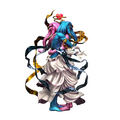 Render from Shin Megami Tensei: Liberation Dx2
 Sprite from Shin Megami Tensei IV
 Sprite from the PlayStation version of Devil Summoner: Soul Hackers
 Sprite from the Nintendo 3DS version of Devil Summoner: Soul Hackers
 Sprite from Devil Survivor 2
 Sprite from Devil Survivor 2: Record Breaker
 Icon from Devil Survivor 2
 Graphic from Devil Survivor 2: Record Breaker
 Icon from Devil Survivor 2: Record Breaker


