Nüwa,[a] known archaically as Nüwo,[b] is the creator of mankind in Chinese folk religion, Confucianism, Buddhism, and Daoism.
The concept of Nüwa predates recorded history, with her earliest mentions being in the Classic of Mountains and Seas's[c] Great Western Wastelands,[d] which would disseminate into Chinese folk religion, Confucianism, Buddhism, and Daoism. In the Classic, she is described as being an ancient goddess and ruler who repopulated humanity after disaster. She is described as having a human face and snake body, undergoing seventy transformations in a day.[1] The image of Nüwa tends to correlate with how women are seen in Chinese society. For the first six centuries, she was seen as an ancient goddess, whereas later historians would place her with Lü Zhi and Wu Zetian as a femme fatal or usurper.[2]
The Spring and Autumn Annals[e] places her alongside the Flame Emperor Shennong[f] and her brother (or husband) Fu Xi[g] as the Three Sovereigns defining the Three Sovereigns and Five Emperors period.[h][3] Huainanzi expresses the world beforehand as being exceedingly chaotic: Savage beasts preyed on man, fires burned unendingly, and floods spread ceaselessly. The nine states were split and the four corners of the Earth were shattered. To resolve the chaos, Nüwa would melt five different-coloured stones to patch the sky, sever the four legs of the giant turtle Ao[i] to erect the four pillars supporting the sky, kill Heilong to save Jizhou,[j] and use reed ash to stave off flooding.[4] The Three Sovereigns never set up any laws or regulations in their creation myth, only leaving behind their virtue.[4] According to Classic of Mountains and Seas, she then birthed ten goddesses from her intestines, who would repopulate the Earth after disaster, thus her moniker as the creator of mankind.[5]
In the event of torrential downpours that don't let up, Wang Chong's[k]Lunheng[l] records that people would give sacrifices to Nüwa in hopes of her repairing the situation.[6]
Design
Illustration of Nüwa by Jiang Yinghao (蒋应镐) based on Classic of Mountains and Seas.
The appearance of Nüwa in Shin Megami Tensei V is derived from the Classic of Mountains and Seas, but differs significantly in appearance. The snake motif is reflected in her snake form, albeit not forming her torso and instead being connected to her head. Her human form reflects the appearance of a classical Chinese noblewoman.
Recognized as one of the sovereigns, she is said to have the head of a human and a body of a serpent. She is also known to be responsible for the creation of humanity, having created them from mud. Legend tells that when one of the four pillars said to hold up the world broke, she repaired it. Furthermore, her colleague Fuxi is typically labeled as either her brother or her husband, depending on what version of her story is told.
Snake: A goddess that appears in Chinese mythology. Recognized as one of the sovereigns, she is said to have the head of a human and a body of a serpent, and is also known to be responsible for the creation of humanity, having created them from mud. Legend tells that when one of the four pillars said to hold up the world broke, she repaired it. Furthermore, her colleague Fuxi is typically labeled as either her brother or her husband depending what version of her story is told.
She takes this serpentine form when unleashing a portion of her power, though she is capable of far more.
Nahobino: A goddess that appears in Chinese mythology. Recognized as one of the sovereigns, she is said to have the head of a human and a body of a serpent, and is also known to be responsible for the creation of humanity, having created them from mud.
She assumed the form of a Nahobino after fusing with the bearer of her Knowledge, Shohei Yakumo.
Recognized as one of three sovereigns, she is said to have the head of a human and body of a serpent. As a demigod, she is also known to be responsible for the creation of humanity, having created humans from mud. Legend says that when one of the four pillars said to hold up the world broke, she repaired it. Fuxi, also of the three sovereigns, is typically labeled as either her brother or her husband depending on what version of her story is told.
Snake: A goddess that appears in Chinese mythology.
Recognized as one of three sovereigns, she is said to have the head of a human and body of a serpent. As a demigod, she is also known to be responsible for the creation of humanity, having created humans from mud. Legend says that when one of the four pillars said to hold up the world broke, she repaired it. Fuxi, also of the three sovereigns, is typically labeled as either her brother or her husband depending on what version of her story is told.
She takes this serpentine form when unleashing a portion of her power, though she is capable of far more.
Nahobino: A goddess that appears in Chinese mythology.
Recognized as one of three sovereigns, she is said to have the head of a human and body of a serpent. As a demigod, she is also known to be responsible for the creation of humanity, having created humans from mud.
She assumed the form of a Nahobino after fusing with the bearer of her Knowledge, Shohei Yakumo.
This appearance section is a stub. You can help Megami Tensei Wiki by expanding it.
No reason provided.
Nuwa is first encountered in the Tokyo Diet Building, having routed the forces of Bethel within the building. Assuming the Nahobino is reinforcements for Bethel, she transforms into her demon form and attacks him. Midway though their battle her partner Shohei Yakumo interrupts with intention to kill the Nahobino, only for Nuwa to dissuade him out of respect for the young mans resolve, to which Yakumo begrudgingly relents. With the hostilities ended, the Nahobino takes the opportunity to learn more about the pair, being answered that they oppose the angels of Bethel and the demons of Chaos equally, the former for oppression and the latter self serving opportunism.[7]
↑Sun, Jiankun. 2021. Fantastic Creatures of the Mountains and Seas: A Chinese Classic. First English-language edition. New York: Arcade Publishing.《山海经|大荒西经》:女蜗,古神女而帝者,人面蛇身,一日中七十变。
↑Sun, Jiankun. 2021. Fantastic Creatures of the Mountains and Seas: A Chinese Classic. First English-language edition. New York: Arcade Publishing.
↑Sun, Jiankun. 2021. Fantastic Creatures of the Mountains and Seas: A Chinese Classic. First English-language edition. New York: Arcade Publishing.《山海经|大荒西经》:有神十人,名曰女蜗之肠,化为神,处栗广之野,横道而处
↑"Nuwa: The God of Law has warred with the other gods since time immemorial. However, the God of Law gained the upper hand when He robbed the other demons of their Knowledge, debasing them to their current states. Both God and his cronies in Bethel have absolute faith in the rule of law, and His armies continue to meddle in this realm to protect His order. Such Zealotry cannot be permitted. Ergo, these angels were dealt with accordingly. Which is not to say those that rebel against the God of Law are any better, of course. Opportunistic cretins, for the most part, seeking chaos to fulfill their own selfish desires." Shin Megami Tensei V. Developed by ATLUS.

 Shin Megami Tensei V


 English
 Japanese
 Simplified Chinese


 Traditional Chinese
 Korean
 Artwork of Shohei Yakumo and Nuwa from Shin Megami Tensei V
 Artwork from Shin Megami Tensei V
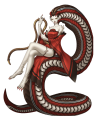 Artwork of Nuwa's Snake form from Shin Megami Tensei V
 Render of Nuwa's Nahobino form from Shin Megami Tensei V
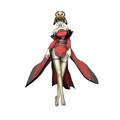 Render from Shin Megami Tensei: Liberation Dx2
 Sprite from Last Bible III
 Sprite from Ronde
 Icon from Shin Megami Tensei V
 Icon of Nuwa's Snake form from Shin Megami Tensei V
 Icon of Nuwa's Nahobino form from Shin Megami Tensei V
 Model from Shin Megami Tensei V
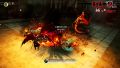 Nuwa using Sacrifice of Clay in Shin Megami Tensei V
 Nuwa's introduction in Shin Megami Tensei V
 Nuwa's introduction in Shin Megami Tensei V: Vengeance
 Nuwa using Sacrifice of Clay in Shin Megami Tensei V: Vengeance
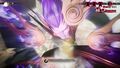 Nahobino Nuwa using Rising Storm Dragon in Shin Megami Tensei V: Vengeance


