Relief of a centaur (left) doing battle with a Lapith (c. 447-438 BC)
Centaurs[a] originate from Greek mythology, being creatures with the upper body of a man attached to the lower body of a horse. There are multiple myths detailing their origin, with one being that they were born when king Ixion was deceived by Zeus into revealing his lust for Hera by shaping a cloud to resemble Hera, which Ixion then assaulted and revealing his duplicity, for which Zeus annihilated him with his thunderbolt and damned him to Tartarus. The cloud became known as Nephele and bore two children, one of which was the first centaur, Centaurus. Another myth states that Centaurus was the human child of Ixion and Nephele that mated with the mares of Magnesia, the offspring of which were the first centaurs.
Centaurs had varying depictions across mythology. At times they were wild and untamed, kidnapping and assaulting women, as well as having connections to the cult of Dionysus. At other times they were intellectual and civil, such as Chiron who mentored various Greek heroes in the arts of battle and medicine throughout mythology, including Heracles, Jason, and Achilles.
Historians theorise that the myth of the centaur came from the people of Greece encountering nomadic people that rode upon horses, making the people unfamiliar with horse-riding believe that the rider and steed were a single entity.
Design
This design section is a stub. You can help Megami Tensei Wiki by expanding it.
A half-man, half-horse creature of Greek lore. The top half is human and the bottom half is a horse.
They are often depicted as wise and noble mentors of heroes. A common theory about their origins is that a non-riding culture saw men from another civilization mounted on horses and thought them to be half-horse.
A half-man, half-horse creature of Greek lore. The top half is human and the bottom half is a horse. They are often depicted as wise and noble mentors of heroes. A common theory about their origin is that a non-riding culture saw men from another civilization mounted on horses and thought them to be half-horse.

 Devil Children Light Book and Dark Book


 English
 Japanese
 Korean
 Artwork from Digital Devil Story: Megami Tensei II
 Artwork from Shin Megami Tensei IV
 Artwork from Shin Megami Tensei IV: Apocalypse
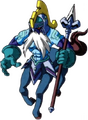 Artwork from Devil Children Light Book and Dark Book
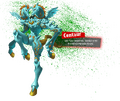 Official character bio for Shin Megami Tensei IV: Apocalypse
 Sprite from Digital Devil Story: Megami Tensei II
 Animated sprite from Digital Devil Story: Megami Tensei II
 Sprite from Kyūyaku Megami Tensei
 Animated sprite from Kyūyaku Megami Tensei
 Sprite from Shin Megami Tensei IV
 Sprite from Shin Megami Tensei IV: Apocalypse
 Sprite from the Game Boy version of Last Bible II
 Sprite from the Game Boy Color version of Last Bible II
 Sprite from Last Bible III
 Sprite from Last Bible Special
 Sprite from Devil Children Light Book and Dark Book and Devil Children Fire Book and Ice Book


