Pottery depicting Hades' abduction of Persephone (c. 350-325 BC)
Persephone,[a] also known by the name Kore[b] meaning "the maiden", is a goddess of Greek mythology. The daughter of Demeter and Zeus, she is best known for the myth of her abduction. The god of the underworld Hades fell in love with Persephone and seeking to marry her sought out her father Zeus, who granted his approval. However knowing that Demeter would never allow her daughter to marry, Zeus instructed Hades to abduct Persephone so that Demeter would not know. On a day when Persephone was in a field gathering flowers, Hades erupted from the earth on a chariot and stole her to the underworld.
With the disappearance of her daughter, Demeter desperately searched the earth to find Persephone and prevents any vegetation from growing. Eventually she learns from the god Helios, who was witnessing the abduction from the sun, that it was Hades that took Persephone. Enraged, she allows famine to kill countless humans and forces Zeus to request that Hades return Persephone from the underworld. While Hades acquiesces to the request, he tricks Persephone into eating pomegranate seeds from the underworld, and as she has eaten to food of the underworld she is bound to spend three months in the underworld each year, acting as a mythological explanation of winter as Demeter is said to allow the world to suffer as it did when she was searching for her daughter and Persephone's return signalling the end. From this, Persephone is considered the goddess of spring.
As the wife of Hades, she is considered the queen of the underworld and given the epithet of "Dread Persephone" or "Despoina" meaning "The Mistress", and is considered Hades equal in power and authority over the dead. Their children are debated, sometimes being Zagreus and Melinoë though various myths attribute the father of the two as Zeus rather than Hades. In Orphic tradition the Erinyes are the offspring of Persephone and Hades rather than the children of Nyx.
Design
Persephone is a red-haired woman who is vertically bisected, with both halves connected only by an amber colored substance. The right half has an entirely blue eye, an apple in her hand, and predominantly white skin with black markings in the form of stripes and a sun over her breast. The left half instead has an entirely red eye, holds a pomegranate, and has predominantly black skin with silver markings; the one over the breast is a five-pointed star. The division into two parts represents the division of Persephone's time between the underworld and the earth.[1]
The goddess who became Hades's wife in Greek lore. She is said to have the power to bring fertility to the earth.
While playing with the Oceanids, the earth cracked and Hades appeared to take her away to the underworld. Without her, the earth grew barren, but she was able to return for several months of each year, bringing fertility back while she was free.
The goddess who became Hades' wife in Greek lore. She is said to have the power to bring fertility to the earth.
While playing with the Oceanids, the earth cracked and Hades appeared to take her away to the underworld. Without her, the earth grew barren, but she was able to return for several months of each year, bringing fertility back while she was free.
The goddess who became Hades' wife in Greek lore. She is said to have the power to bring fertility to the earth. While playing with the Oceanids, the earth cracked and Hades appeared to take her away to the underworld. Without her, the earth grew barren, but she was able to return for several months of each year, bringing fertility back while she was free.
The goddess that became Hades' wife in Greek mythology and who is said to have the power to bring fertility to the earth. While playing with the Oceanids, the earth cracked and Hades appeared and took her away to the underworld. Without her, the earth grew barren, but she was allowed to return by the other gods for several months of each year, bringing fertility back while she was free.
The goddess who became Hades's wife in Greek lore. She is said to have the power to bring fertility to the earth. While playing with the Oceanids, the earth cracked and Hades appeared to take her away to the underworld. Without her, the earth grew barren, but she was able to return for several months of each year, bringing stability back while she was free.
Translation: The goddess who became the wife of the king of the underworld, Hades. Said to have the power to bring fertility to the land.
Origin: Greece
Persephone appears in Greek myth as the wife of the king of the underworld, Hades, and is considered to be the queen of the underground realm. As a result of her plucking flowers and playing with the children of Oceanus, the ground suddenly split apart before her, and from the fissure came the king of the underworld, Hades, who took her to the the underground realm. As she was also a goddess of fertility, the earth withered, though she received the mournful gods' voices and was allowed to live aboveground for a third of each year, bringing back fertility to the land.
Translation: The daughter of the almighty god, Zeus, and the god of harvest, Demeter. To make her his wife, the king of the underworld, Hades, took Persephone into the underworld and later made her the queen of the underworld. Furthermore, in Roman myth, she is called Proserpina.
↑"ペルセポネーって、かっこいい名前ですよね。これはギリシアの季節や収穫を表わす神様なんだけど、冬の間は収穫がないじゃないですか。だからその間は冥界に行ってるらしいです。あっちに行ったりこっちに行ったりしてる神様なんで、イメージ的にはふたつに分かれてるぞっていう感じにしました。手には冥界の果物であるザクロと、豊饒のシンボルであるリンゴを持たせてます。やっぱりこれも、似たような話がシュメールの死神モトがらみでありますよね。" Devil Summoner: Soul Hackers no Subete (1998), CB's Project. Published by Aspect. Japanese. p. 202. ISBN-13: 978-4-7572-0011-1.


 English
 Japanese
 Korean
 Artwork from Devil Summoner: Soul Hackers
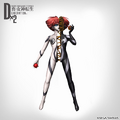 Render from Shin Megami Tensei: Liberation Dx2
 Sprite from Shin Megami Tensei: Strange Journey
 Sprite from Shin Megami Tensei IV
 Sprite from the PlayStation version of Devil Summoner: Soul Hackers
 Sprite from the Nintendo 3DS version of Devil Summoner: Soul Hackers
 Sprite from the PlayStation Portable version of Persona 2: Innocent Sin
 Sprite from Shin Megami Tensei Trading Card: Card Summoner
 RTS icon from Shin Megami Tensei: Nine
 Portrait graphic from Shin Megami Tensei: Strange Journey
 Graphic from Kaneko Kazuma Dennō Akuma Zukan
 Model from Shin Megami Tensei: Nine


