Pottery depicting Polyphemus (far right) being blinded by Odysseus (c. 660-650 BC)
Cyclopes[a] are creatures in Greek folklore. They are giants with a single eye. There are multiple groups of cyclopes within mythology, such as various children of Poseidon or the Elder cyclopes that were the children of Gaia and Uranus that created the weapons of Zeus and his brothers. The most notable incident involving a cyclops is in Homer's Odyssey, in which the titular Odysseus claims his name is "Nobody" and blinds the cyclops Polyphemus, thereby tricking the cyclops into saying that "Nobody" is murdering him so that none of the other cyclopes would help him.
Although the Ancient Greeks believed that the name was derived from κύκλος kýklos ("circle") and ὤψ ōps ("eye"), and thus meant "round-eyed", it is possible the name derives from an older Indo-European myth of a cattle thief (Proto-Indo-European: *Pḱúklōps).[1]
Design
Cyclops' designs in Digital Devil Story: Megami Tensei II and Shin Megami Tensei, featuring a horn and pointed ears, strongly resemble the cyclops designed and animated by Ray Harryhausen for the 1958 film The 7th Voyage of Sinbad.
Origin: Greece One-eyed giants born of Gaia and Uranus. They were the helpers of Hephaestus, the blacksmith god, and made excellent weapons. Uranus feared their power and locked them away in Tartarus, but Zeus released them.
Cyclops appears starting on the 6th floor of Mecha Fortress, floor 31 overall. He creates earthquakes which can stun the player regardless of where they are on the map. It takes more shots to kill than an average enemy, surviving a hit from Jack the Ripper's knife.
Pixie says the following on the floor in which he is first encountered:
Cyclops roams this floor. He's a powerful giant who can create earthquakes. Attack several times to defeat him...you can do it!
↑"Das Griechische scheint keine Spur des idg. *peku aufgehoben zu haben[...]. Aber könnte nicht ein altes *pku- in Κύκλωψ, welches also eigentlich „Viehdieb“ wäre, stecken?" Translation: "Greek appears to retain no trace of the Indo-European *peku[...]. But couldn't there be a remnant of *pku- in Κύκλωψ, which would actually make it “cattle thief”?" "Etymologische Vexierbilder", Thieme, P. Zeitschrift Für Vergleichende Sprachforschung Auf Dem Gebiete Der Indogermanischen Sprachen, 69(3–4), pp. 172–178. Published 1951 by Vandenhoeck & Ruprecht. German.


 English
 Japanese
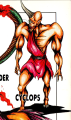 Artwork from Digital Devil Story: Megami Tensei II
 Artwork from the Super Famicom version of Shin Megami Tensei
 Artwork from Devil Children Light Book and Dark Book
 Sprite from Digital Devil Story: Megami Tensei
 Sprite from Digital Devil Story: Megami Tensei II
 Animated sprite from Digital Devil Story: Megami Tensei II
 Sprite from Kyūyaku Megami Tensei
 Animated sprite from Kyūyaku Megami Tensei
 Sprite from the Super Famicom version of Shin Megami Tensei
 Sprite from the Mega-CD version of Shin Megami Tensei
 Sprite from the PlayStation version of Shin Megami Tensei
 Sprite from the PlayStation version of Shin Megami Tensei II
 Sprite from the PlayStation version of Shin Megami Tensei if...
 Sprite from Last Bible III
 Sprite from Shinyaku Last Bible III: Mugen no Eiyū
 Sprite from Devil Children Light Book and Dark Book and Devil Children Fire Book and Ice Book
 Credit sprite featuring Cyclops alongside the other enemies from Jack Bros.
 RTS icon from Shin Megami Tensei: Nine
 Model from Shin Megami Tensei: Nine
 Model from Shin Megami Tensei: Imagine


