Mithras
| Mithras | |
| ミトラス | |
SH1P5X
Artwork from Devil Summoner: Soul Hackers
Artwork from Persona 5: The Phantom X | |
| Other Name(s) | Mitra Shin Megami Tensei: Strange Journey Shin Megami Tensei: Strange JourneyDevil Summoner: Soul Hackers Dark Sun Persona 5Persona 5 Royal |
| Origin | Roman culture |
| Race(s) | Tyrant |
| Alignment(s) | Dark-ChaosShin Megami Tensei: Strange Journey Shin Megami Tensei: Strange Journey Redux Shin Megami Tensei V Shin Megami Tensei V: Vengeance Devil Summoner: Soul Hackers Chaos Shin Megami Tensei IVShin Megami Tensei IV: Apocalypse |
| Arcana | ChariotPersona 3 Reload Sun Persona 5Persona 5 Royal Persona 5 Strikers Temperance Persona Q2: New Cinema Labyrinth |
| Voice Actor(s) | Wataru HatanoShin Megami Tensei: Strange Journey Redux |


Mithras is a Demon in the Megami Tensei franchise.
Profile
Origin
Mithras is the supreme deity of the Mithraic mysteries, a mystery cult that flourished throughout the Roman Empire from the late 1st to the 4th century CE. Mithras's name derives from the Iranian god Mithra, a deity of contracts, light, and justice whose origins trace back to an Indo-Iranian root meaning "to bind" and whose earliest historical recording appears in a Bronze Age treaty between the Hittites and Mitanni around 1380 BCE. Despite the connection in name and shared associations with light, modern scholars generally agree that there is little direct continuity between ancient Iranian Mithra worship and Roman Mithraism.[1] While 19th-century scholars such as Franz Cumont argued that Roman Mithraism was simply Zoroastrianism in Roman guise, contemporary consensus treats it as a distinct Greco-Roman new religious movement that adopted a heavily Persianized aesthetic. Roman initiates worshipped in dark, underground chambers called Mithraea and identified ritually with Persia, viewing Zoroaster as the founder of their mysteries and dressing Mithras in stereotypical Persian attire, including trousers and a Phrygian cap. Precursors to the Roman cult likely emerged in the syncretic Hellenistic buffer kingdoms of Anatolia, such as Commagene and Pontus, where Persian and Greek religious traditions merged before spreading westward through the Mediterranean.
Because the Roman worshippers of Mithras left no surviving holy books or theological scriptures, modern understanding of the god's mythology is largely reconstructed through archaeological reliefs, insider inscriptions, and hostile accounts by early Christian writers like Justin Martyr and St. Augustine. Based on sequential stone reliefs found across the empire, such as those in Dieburg and Dura-Europos, the mythic life of Mithras follows a distinct narrative cycle. Mithras is depicted as being born fully formed from a rock (a scene known as petrogenesis), emerging naked while wearing a Phrygian cap and holding a torch and a dagger. Ancient writers like Jerome suggest that this rock birth was associated with the cosmic desires or dreams of the sleeping god Saturn. Following his birth, Mithras pursues, wrestles, and captures a wild bull, earning him the title Boukolpos Theos ("the god who steals the bull").
The central and most ubiquitous icon of the religion is the tauroctony, a scene depicting Mithras slaying the captured bull inside a cave by driving a dagger into its neck. Serving a role within Mithraism similar to the crucifix in Christianity, the tauroctony features a rich set of recurring symbols: a dog and snake leaping toward the wound to lap up the bull's blood, a scorpion clamping onto the bull's testicles, a raven, and the torchbearers Cautes and Cautopates. Scholars interpret this central act of sacrifice as both a generative and cosmic event. In generative readings, the bull's death brings forth life, fertility, and cosmic renewal, often depicted by wheat sprouting from the bull's tail or wound, releasing eternal blood that brings salvation and transfiguration to the world. Astrological interpretations view the figures surrounding the bull as representations of constellations (Taurus, Canis Major, Hydra, Scorpius, and Corvus), positioning Mithras as a cosmocrator or universal ruler capable of shifting the heavens and governing the ages. Following the slaying of the bull, Mithras shares a ritual banquet with the sun god Sol Invictus over the carcass of the slain animal before ascending to the heavens in Sol's chariot, an act that served as the primary model for the sacred communal meals shared by initiates inside the Mithraeum.
Design
According to Kazuma Kaneko, the twelve zodiac signs engraved on the boulder reference Mithras’ association with the zodiac.[2] Mithras is depicted wielding a weapon, reflecting his role as a god of war and aligning with traditional representations of his birth holding a dagger.[2] The illumination emanating from the rock emphasizes his emergence.
Gameplay
- For complete gameplay information, see Gameplay:Mithras.
Compendium

|
This section has content in need of translation. |
| The content in this section is missing a translation. You can help Megami Tensei Wiki by adding one. |
| Compendium Entries | |
|---|---|
| Shin Megami Tensei: Strange Journey |
A sun deity who was worshipped in the Roman Empire from the 1st to the 4th century AD. The rituals of the religion were secretive, but it is believed that they had to do with covering oneself in the blood of sheep and bulls. He was said to be reborn after death, and a festival was held on the winter solstice for him. |
| Shin Megami Tensei IV |
A sun deity who was worshipped in the Roman Empire from the 1st to the 4th century AD. The rituals of the religion were secretive, but it is believed that they had to do with covering oneself in the blood of sheep and bulls. He was said to be reborn after death, and a festival was held on the winter solstice for him. |
| Shin Megami Tensei IV: Apocalypse |
A sun deity who was worshipped in the Roman Empire from the 1st to the 4th century AD. |
| Shin Megami Tensei V |
A sun deity who was worshiped in the Roman Empire from the 1st to the 4th century AD. The rituals of the religion were secretive, but it is believed they entailed covering oneself in the blood of sheep and bulls. He was said to be reborn after death, inspiring worshipers to hold a festival each winter solstice. |
| Shin Megami Tensei V: Vengeance | |
| Devil Summoner: Soul Hackers(3DS) |
A sun deity who was worshiped in the Roman Empire from the 1st to the 4th century AD. |
| Soul Hackers 2 |
A sun deity who was worshiped in the Roman Empire from the 1st to the 4th century AD. The rituals of the religion were secretive, but it is believed they entailed covering oneself in the blood of sheep and bulls. He was said to be reborn after death, inspiring worshipers to hold a festival each winter solstice. |
| Persona 3 Reload |
A sun deity who was worshiped in the Roman Empire from the 1st to the 4th century AD. He was said to be reborn after death, and a festival was held on the winter solstice for him. |
| Persona 5 |
A sun deity who was worshiped in the Roman Empire from the 1st to the 4th century AD. He was said to be reborn after death, and a festival was held on the winter solstice for him. |
| Persona 5 Royal | |
| Persona Q2: New Cinema Labyrinth |
A sun deity who was worshipped in the Roman Empire from the 1st to the 4th century AD. He was said to be reborn after death, and a festival was held on the winter solstice for him. |
| Persona 5 Strikers |
A sun deity who was worshipped in the Roman Empire from the 1st to the 4th century AD. He was said to be reborn after death, and a festival was held on the winter solstice for him. |
| Persona 5 Tactica |
A sun deity who was worshipped in the Roman Empire from the 1st to the 4th century AD. He was said to be reborn after death, and a festival was held on the winter solstice for him. |
| Persona 5: The Phantom X |
A sun deity who was worshipped in the Roman Empire from the 1st to the 4th century AD. He was said to be reborn after death, and a festival was held on the winter solstice for him. |
| Kētai Akuma Densho |
イランやインドを中心に興った太陽神。後にローマに至る広い地域で信仰された。 出身地:ローマミトラスはミスラとも呼ばれる様々な時代の異なった国々で信仰されていた神で、主にイランやインド、ペルシアなどで信仰を受けていた。後にローマでミトラス教としても成立し、キリスト教徒対峙する最も主要な宗教にまでなった。ミトラスは「征服されざる太陽の誕生日」と呼ばれる12月25日に太陽神とその母の近親相姦から生まれたとされる。この逸話は誕生の内容に引き継がれていると言われる。Translation: |
| Kaneko Kazuma Dennō Akuma Zukan | ペルシアの救世主とされる神で、人間が悪と戦うときに空から遣わされる。古代ローマにおいても広く信仰され、ローマでは秘儀の神、あるいは戦争の神として崇められた。ミトラスを奉る儀式では雄牛を捧げることが多く、またミトラス自身も牛を屠る姿で描かれることが多いという。Translation: |
Game Appearances
Shin Megami Tensei: Strange Journey
Mithras (known as Mitra in the original DS version) is the ruling demon of Sector Bootes.
Nomenclature
| Language | Name | Meaning |
|---|---|---|
 English English
|
MitraShin Megami Tensei: Strange Journey Devil Summoner: Soul Hackers | |
| Mithras | ||
| Dark SunPersona 5 Royal (Shadow) | ||
 Japanese Japanese
|
ミトラス Mitorasu | Mithras |
| 闇穴の太陽Persona 5 Royal (Shadow) Anketsu no Taiyō |
Sun of the Dark Pit | |
 Simplified Chinese Simplified Chinese
|
米特拉斯 Mǐtèlāsī | Mithras |
| 暗穴的太阳Persona 5 Royal (Shadow) Ànxué de Tàiyáng |
Sun of the Dark Pit | |
   Traditional Chinese Traditional Chinese
|
米特拉斯 Mǐtèlāsī | Mithras |
| 闇穴的太陽Persona 5 Royal (Shadow) Ànxuè de Tàiyáng |
Sun of the Dark Pit | |
 French French
|
Mithras | |
| Soleil noirPersona 5 Royal (Shadow) |
Black Sun | |
 German German
|
Mithras | |
| Schwarze SonnePersona 5 Royal (Shadow) |
Black Sun | |
 Italian Italian
|
Mithras | |
| Sole oscuroPersona 5 Royal (Shadow) |
Dark Sun | |
 Korean Korean
|
미트라스 Miteuraseu | Mithras |
| 암혈闇穴의 태양太陽Persona 5 Royal (Shadow) Amhyeor-ui Taeyang |
Sun of the Dark Pit | |
 Polish Polish
|
Mitras | |
 Brazilian Portuguese Brazilian Portuguese
|
Mitras | |
 Russian Russian
|
Митрас Mitras | Mithras |
 Peninsular Spanish Peninsular Spanish
|
Mitras | |
| Sol oscuroPersona 5 Royal (Shadow) |
Dark Sun | |
 Turkish Turkish
|
Mitras | |
Gallery
-
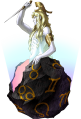 Artwork from Devil Summoner: Soul Hackers
 -
 Artwork from Persona 5: The Phantom X
 -
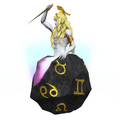 Render from Shin Megami Tensei: Liberation Dx2
 -
 Render from Persona 5
 -
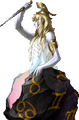 Boss sprite from Shin Megami Tensei: Strange Journey
 -
 Sprite from Shin Megami Tensei IV
 -
 Sprite from the PlayStation version of Devil Summoner: Soul Hackers
 -
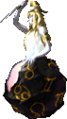 Sprite from the Nintendo 3DS version of Devil Summoner: Soul Hackers
 -
 Sprite from Shin Megami Tensei Trading Card: Card Summoner
 -
 Portrait graphic from Shin Megami Tensei: Strange Journey
 -
 Icon from Shin Megami Tensei V
 -
 Icon from Soul Hackers 2
 -
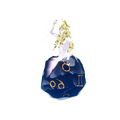 Graphic from Persona 3 Reload
 -
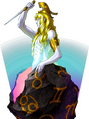 Graphic from Persona Q2: New Cinema Labyrinth
 -
 Battle icon from Persona 5 Strikers
 -
 Battle icon from Persona 5: The Phantom X
 -
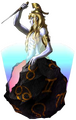 Graphic from Kaneko Kazuma Dennō Akuma Zukan


Videos
References
- ↑ "It is nevertheless impossible on present evidence to trace much if any direct continuity between the Achaemenid, or more vaguely Iranian, cult and the Roman one." Romanising Oriental Gods: Myth, Salvation and Ethics in the Cults of Cybele, Isis and Mithras (2008). Published by Brill. p. 80. ISBN-13: 978-90-04-13293-1. https://doi.org/10.1163/ej.9789004132931.i-486
- ↑ 2.0 2.1 Translation: "There are a lot of Mithra-like figures around the world, so it seems he was another god whose worship transcended time and place; I do think he also had some relation with bull worship though. He seems to be connected to the zodiac, and it is said he was born from a rock, so I decided to draw him emerging from a boulder covered with the 12 signs. I also gave him a weapon, since he is a god of war. I find the image of the light from the rock reflecting on him rather lovely. (Kaneko)" Devil Summoner: Soul Hackers no Subete, CB's Project. Published by Aspect. Japanese. Translation by dijeh.
- Pages needing translations
- Demons from Roman Culture
- Demons in Shin Megami Tensei: Strange Journey
- Bosses in Shin Megami Tensei: Strange Journey
- Demons in Shin Megami Tensei: Strange Journey Redux
- Bosses in Shin Megami Tensei: Strange Journey Redux
- Demons in Shin Megami Tensei IV
- Demons in Shin Megami Tensei IV: Apocalypse
- Demons in Shin Megami Tensei V
- Demons in Shin Megami Tensei V: Vengeance
- Guardians in Shin Megami Tensei: J
- Demons in Shin Megami Tensei: Liberation Dx2
- Demons in Devil Summoner: Soul Hackers
- Demons in Soul Hackers 2
- Demons in Devil Summoner: Soul Hackers: Intruder
- Personas in Persona 3 Reload
- Personas in Persona 5
- Shadows in Persona 5
- Personas in Persona 5 Royal
- Shadows in Persona 5 Royal
- Personas in Persona Q2: New Cinema Labyrinth
- Personas in Persona 5 Strikers
- Personas in Persona 5 Tactica
- Personas in Persona 5: The Phantom X
- Shadows in Persona 5: The Phantom X
- Demons in Shin Megami Tensei Trading Card: Card Summoner
- Demons in Kētai Akuma Densho
- Demons in Kaneko Kazuma Dennō Akuma Zukan