Kaso, known in Chinese as Huoshu,[a] is a creature mentioned in Book of Gods and Strange Things.[b] It is said to live on the outskirts of the southern wastelands, where there is a volcano around 40 li long and 50 li wide. Huoshu are said to be born of wood that has been burned to cinders, live in volcanoes, and cannot burn themselves. They weigh around 1,000 jin, and have white fur around 2 chi long, which can be woven into a sort of silk that can be cleaned through immolation.[1] The 3rd Century Records of Wu[c] note Huoshu as existing in the Rinan Commandery, an area within Han-controlled southern Vietnam. The text details that clothes made with Huoshu's pelt would purify themselves when burned. Clothes made in this way were called 火浣布huǒhuànbù.[2]
Kaso, in Japanese folklore, appears in the monogatari known as Tale of the Bamboo Cutter.[d] Within the story, Princess Kaguya[e] is told by an old man who raised her to answer five suitors who loved her. While she did not want to, she did so as he was getting on in years. The catch was that these tasks were essentially impossible. The third suitor, Abe no Miushi, Minister of the Right,[f] was told to go to Tang dynasty China and bring back the pelt of Kaso. The impossibility was known to all, but Princess Kaguya made no compromises. Abe no Miushi, instead of going to China, mailed a merchant named Wang Qing[g] and offered him any amount of money to receive Kaso's hide. He received it, and brought it to Princess Kaguya. While initially ecstatic, when tested by throwing it into fire, it burnt instantly: Abe no Miushi had been conned, and thus failed the condition given to him.[3][4]
Design
Edo period illustration of Kaso from Wakan Sansai Zue (和漢三才図会)
Kaso's design is vaguely derived from its description in Book of Gods and Strange Things, but with the body being made of pure fire rather than being incombustible fur.
A rat said to live in fire in ancient Chinese myths.
The fur of these creatures is said to never burn in fire. In the Japanese story "Taketori Monogatari," Princess Kaguya asks one of her suitors to obtain a robe made from the fur.
A rat said to live in fire in ancient Chinese lore.
The fur of these creatures is said to never burn in fire. In the Japanese story "Taketori Monogatari," Princess Kaguya asks one of her suitors to obtain a robe made from the fur.
A rat said to live in fire in ancient Chinese lore. The fur of these creatures is said to never burn in fire. In the Japanese story "Taketori Monogatari," Princess Kaguya asks one of her suitors to obtain a robe made from the fur.
A rat that ancient Chinese myths claimed lived in fire. The fur of these creatures is said to be incombustible. In the Japanese story "Taketori Monogatari," Princess Kaguya asks one of her suitors to obtain a robe made from their fur.
火山の中に住んでいて 自分も 燃えている ネズミの デビル カソの皮に 火をつけようとしても 絶対に 燃えないTranslation: A rat Devil who lives in volcanoes and is also on fire. If you try setting Kaso's skin ablaze, it will never burn.
火山の中に住んでいて 自分も 燃えている ネズミの デビル カソの皮に 火をつけようとしても 絶対に 燃えないTranslation: A rat Devil who lives in volcanoes and is also on fire. If you try setting Kaso's skin ablaze, it will never burn.
↑Dongfang, S. (2022). 神异经 [Book of Gods and Strange Things] (Z. Liu, Trans.; 1st ed.). 巴蜀书社 [Bashu Book Club].
↑《吴录》记载:“日南北景縣有火鼠,取毛為布,燒之而精,名火浣布。”, quoted in 《太平御览》with the original record lost.
↑Sazanami, I. & Sadanami, S. (2025 [1908]). (Yei Theodora Ozaki transl.) The Bamboo-Cutter and the Moon-Child in The Japanese Fairy Book. Available on Wikisource.
↑Wang, Xinxi. (transl.) (2019). 竹取物语 [The Tale of the Bamboo Cutter] in 竹取物语 御伽草子 [The Tale of the Bamboo Cutter & Otogi-zōshi]. 陕西人民出版社 [Shanxi People's Publishing House].
 DemiKids Light Version and Dark Version


 English
 Japanese
 Korean
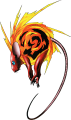 Artwork from Devil Summoner: Soul Hackers
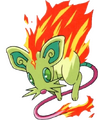 Artwork from Devil Children Light Book and Dark Book
 Sprite from Shin Megami Tensei IV
 Sprite from the PlayStation version of Devil Summoner: Soul Hackers
 Sprite from the Nintendo 3DS version of Devil Summoner: Soul Hackers
 Sprite from Devil Children Light Book and Dark Book and Devil Children Fire Book and Ice Book

