Attis


Attis is a Demon in the Megami Tensei franchise.
Profile
Origin
Attis[a] was an ancient deity of purported Phrygian origin who was worshiped in conjunction with his consort, the mother deity Cybele, by the Greeks and Romans.
Because Attis appears late in the historical record, some scholars, such as Lynn E. Roller, believe that the idea of Attis as a deity originated with the Greeks rather than the Phrygians themselves,[1][2] though he was considered by them to be Phrygian. In this viewpoint, the "original" Phrygian Attis appears to have been the title of a king with a sacred role in the cult of Cybele (Matar), and Attis was still used as a title of the high priest in Hellenistic Phrygia.[1][3] However, the name of Attis may be etymologically related to the Phrygian father deity, Ata, who was worshiped in conjunction with the mother deity Cybele (Matar); compare also Diodorus Siculus's mention of "Papas" (father) as an epithet of Attis.[4]
Other scholars, however, continue to believe that the deity Attis indeed existed amongst the Phrygians, though not in the exact same form as later worshiped by the Greeks and Romans. It is thought that, if there was a deity Attis, he was originally associated with kingship, and he may have been a deified king that was later reinterpreted after Phrygia no longer had its own monarchy.[5] This association with kingship would not be carried over to Attis worship in Rome.[6]
In any case, there are several different versions of the Attis myth in Greek and Roman sources, but most commonly he is portrayed as castrating himself under a pine tree out of mania. Ritual self-castration was practiced by the Galli, the priests of Cybele and Attis, and the castration narratives were likely written to explain this.[7] Below are summaries of some of the narratives.
Diodorus Siculus in his Library of History does not mention castration. Diodorus portrays Attis, whom he says later received the appellation Papas,[b] as a Phrygian youth who was the beloved of Cybele, the daughter of the king of Phrygia and Lydia. When it was seen that she was pregnant, Cybele's father ordered Attis's death and his body left unburied. After this, a pestilence struck Phrygia, whereupon Attis was buried and Cybele was honored as a goddess.[8] Diodorus's account is influenced by euhemerism, an approach wherein the gods are portrayed as historical human beings.[9]
In Ovid's Fasti, explaining why the Galli castrate themselves, it is said that Attis was a handsome Phrygian youth who became a servant of Cybele and vowed to be faithful to her, but he broke this oath by having sexual intercourse with a nymph Sagaritis. Sagaritis was struck dead by Cybele, and Attis, recognizing he broke the oath, castrated himself.[10] Ovid also briefly mentions Attis as being turned into a pine tree in his Metamorphoses.[10]
According to the late accounts of Pausanias (who says it is a local Phrygian legend) and Arnobius (who cites a certain Timotheus), Attis was believed to be the child of Agdistis. Agdistis was an androgyne who was born from Zeus/Jupiter's semen spilled on the ground or on a rock, and Agdistis was castrated by the gods (Pausanias) or forced to castrate themself (Arnobius). An almond tree would grow from either the severed male genitals or from the blood. An almond from this tree would impregnate a woman named Nana, daughter of the river Sangarius or a king of that name, and she would give birth to Attis. Attis was betrothed to the king of Pessinous's daughter, but just as he was to be married, Agdistis appeared. Agdistis caused Attis to be seized by a mania, and Attis emasculated himself, dying from the wound. Zeus/Jupiter thereafter caused Attis's body to never rot.[11]
Design
Attis's design is that of a blue-green-skinned, horned man wrapped in burial cloths. He has detached limbs and holds a knife; these are in reference to Attis's self-mutilation. The pattern on his body is intended to match Cybele's.[12]
Gameplay
- For complete gameplay information, see Gameplay:Attis.
Compendium
| Compendium Entries | |
|---|---|
| Shin Megami Tensei: Strange Journey |
A god of Phrygian descent. He was Cybele's son and consort, but castrated himself and died. Cybele resurrected him as a pine. He came to represent rebirth. |
| Shin Megami Tensei IV |
A god of Phrygian descent. He was Cybele's son and consort, but castrated himself and died. Cybele resurrected him as a pine. He came to represent rebirth. |
| Shin Megami Tensei IV: Apocalypse |
A god of Phrygian descent. He was Cybele's son and consort, but castrated himself and died. Cybele resurrected him as a pine. He came to represent rebirth. |
| Shin Megami Tensei V |
A Phrygian god who symbolizes life, death, and revival. He rejected Cybele's love and was driven mad, dying shortly after castrating himself. Cybele then resurrected him. |
| Shin Megami Tensei V: Vengeance | |
| Devil Summoner: Soul Hackers(3DS) |
A god of Phrygian descent. He was Cybele's son and consort, but castrated himself and died. Cybele resurrected him as a pine. He came to represent rebirth. |
| Persona 3 |
A god of Phrygian decent.[sic] He was Cybele's son and consort, but castrated himself and died. Cybele resurrected him as a pine. He came to to[sic] represent rebirth. |
| Persona 3 FES | |
| Persona 3 Portable | |
| Persona 3 Reload |
A Phrygian god who symbolizes life, death, and revival. He rejected Cybele's love and was driven mad, dying after he castrated himself. Cybele then resurrected him. |
| Persona 4 |
A god of Phrygian descent. He was Cybele's son and consort, but castrated himself and died. Cybele resurrected him as a pine. He came to represent rebirth. |
| Persona 4 Golden | |
| Persona 5 |
A Phrygian god who symbolizes life, death, and revival. He rejected Cybele's love and was driven mad, dying after he castrated himself. Cybele then resurrected him. |
| Persona 5 Royal | |
| Persona Q: Shadow of the Labyrinth |
A god of Phrygian descent. He was Cybele's son and consort, but castrated himself and died. Cybele resurrected him as a pine. He came to represent rebirth. |
| Persona Q2: New Cinema Labyrinth |
A god of Phrygian descent. He was Cybele's son and consort, but castrated himself and died. Cybele resurrected him as a pine. He came to represent rebirth. |
| Persona 5 Tactica |
A Phrygian god who symbolizes life, death, and revival. He rejected Cybele's love and was driven mad, dying after he castrated himself. Cybele then resurrected him. |
| Kētai Akuma Densho |
プリュギアで崇拝される、復活を繰り返す美少年の姿をした神。地母神キュベレの若き恋人とされる。 出身地:トルコプリュギアの偉大な地母神キュベレの、息子であるとも愛人であるとも言われる、美少年の姿をした神。キュベレが生まれた際に切除された男根は、地に落ちた後アーモンドの木となった。その実がサンガリオス河神の娘ナナの体内に入り込んで身ごもらせ、生まれてきた子がアティスであると言われる。キュベレは彼に恋をしたが彼の反応は冷たく、ペッシヌス王の娘と結婚しようとした。キュベレに呪いをかけられた彼は発狂し、自らの手で去勢した後に死んでしまったと言う。Translation: A god worshiped in Phrygia, in the form of a beautiful boy who revives repeatedly. Considered the young lover of the earth mother goddess Cybele. Place of origin: Turkey |
Nomenclature
| Language | Name | Meaning |
|---|---|---|
 English English
|
Attis | |
 Japanese Japanese
|
アティス Atisu | Attis |
 Simplified Chinese Simplified Chinese
|
阿提斯 Ātísī | Attis |
   Traditional Chinese Traditional Chinese
|
阿提斯 Ātísī | Attis |
 French French
|
Attis | Attis |
 German German
|
Attis | Attis |
 Italian Italian
|
Attis | Attis |
 Korean Korean
|
아티스 Atiseu | Attis |
 Polish Polish
|
Attis | Attis |
 Brazilian Portuguese Brazilian Portuguese
|
Átis | Attis |
 Russian Russian
|
Аттис Attis | Attis |
 Peninsular Spanish Peninsular Spanish
|
Atis | Attis |
 Turkish Turkish
|
Attis | Attis |
Gallery
-
 Artwork from Devil Summoner: Soul Hackers
 -
 Render from Persona 5
 -
 Sprite from Shin Megami Tensei IV
 -
 Sprite from the PlayStation version of Devil Summoner: Soul Hackers
 -
 Sprite from the Nintendo 3DS version of Devil Summoner: Soul Hackers
 -
 Sprite from Shin Megami Tensei Trading Card: Card Summoner
 -
 Icon from Shin Megami Tensei V
 -
 Card graphic from Persona 3
 -
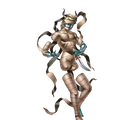 Graphic from Persona 3 Portable
 -
 Graphic from Persona 3 Reload
 -
 Card graphic from Persona 4
 -
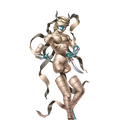 Graphic from Persona 4 Golden
 -
 Graphic from Persona Q: Shadow of the Labyrinth
 -
 Graphic from Persona Q2: New Cinema Labyrinth
 -
 Model from Persona 3
 -
 Model from Persona 3 Reload
 -
 Attis' stats in Shin Megami Tensei: Liberation Dx2
 -
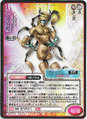 Card No.221 from Shin Megami Tensei Trading Card: 2nd Edition


Videos
Notes
References
- General
- Attis – Between Myth and History: King, Priest and God (2002), Maria Grazia Lancellotti. Published by Brill. ISBN-13: 978-90-04-12851-4. https://doi.org/10.1163/9789004295971
- "The Phrygian Background of Kybele", Birgitte Bøgh. Numen, 54(3), pp. 304-339. Published 2007 by Brill. https://doi.org/10.1163/156852707X211573
- Specific
- ↑ 1.0 1.1 Bøgh 2007, p. 319.
- ↑ Lancellotti 2002, pp. 10-12.
- ↑ Lancellotti 2002, p. 12.
- ↑ Bøgh 2007, p. 321.
- ↑ Lancellotti 2002, pp. 36-40, 75.
- ↑ Lancellotti 2002, pp. 104-105.
- ↑ Lancellotti 2002, p. 47.
- ↑ Lancellotti 2002, pp. 8-9.
- ↑ Lancellotti 2002, p. 41.
- ↑ 10.0 10.1 Lancellotti 2002, p. 2.
- ↑ Lancellotti 2002, pp. 2-5.
- ↑ "キュベレの愛人。というか、キュベレの片想いだったのかな。キュベレは人身供養のときに、いけにえにされた人をバラバラにしたがるらしいんですよ。なんで、コイツは振られたキュベレの呪いで、自ら体をバラバラにして死んだといわれてるんですが、ビジュアル的にバラバラじゃヤバイんで、一応首は切らずにしておきました。体の模様はキュベレと一緒です。やっぱりキュベレが模様ついてるなら、彼氏もつけておかないとマズイかなって(笑)。" Devil Summoner: Soul Hackers no Subete (1998), CB's Project. Published by Aspect. Japanese. p. 238. ISBN-13: 978-4-7572-0011-1.
- Demons from Phrygian Culture
- Demons in Shin Megami Tensei: Strange Journey
- Demons in Shin Megami Tensei: Strange Journey Redux
- Demons in Shin Megami Tensei IV
- Demons in Shin Megami Tensei IV: Apocalypse
- Demons in Shin Megami Tensei V
- Demons in Shin Megami Tensei V: Vengeance
- Demons in Shin Megami Tensei: Liberation Dx2
- Demons in Devil Summoner: Soul Hackers
- Personas in Persona 3
- Personas in Persona 3 FES
- Personas in Persona 3 Portable
- Personas in Persona 3 Reload
- Personas in Persona 4
- Personas in Persona 4 Golden
- Personas in Persona 5
- Personas in Persona 5 Royal
- Personas in Persona Q: Shadow of the Labyrinth
- Personas in Persona Q2: New Cinema Labyrinth
- Personas in Persona 5 Tactica
- Personas in Persona Mobile Online
- Demons in Shin Megami Tensei Trading Card: Card Summoner
- Demons in Kētai Akuma Densho