Bailong as seen in 随筆辞典 Zuihitsu Jiten (1766), illustrating Edo period story 甲子夜話 Kōshi Yawa
Origin
Originally, Bailong[a] was associated with a water deity known as the Dragon King,[b] which revolved around directional symbolism. In this religion, Bailong represented the west direction, autumn season, metal, the white sky, and the refinement of arsenic, silver, and mercury over 900 years. Being one of five directional dragons, Bailong is associated with Heilong, Qinglong, Chilong, and Huanglong.[1] These qualities were eventually adopted into Daoist and folk religion ritual practice.
In modern day, Bailong is seen as the dragon form of the White Emperor[c] (Baidi), one of the Five Regions' Highest Deities[d] and a manifestation of Shangdi. It is associated with the west, metal element, and autumn, equivalent with Baihu, and, furthermore, represents the planet Venus. As a human, the White Emperor was named Shaohao.[e] According to Youxue Qionglin,[f] Baidi comes from the Western Chinese deity Rushou,[g] who governs over punishment, harvest, and metal. Thus, Baidi presides over the trigram 兑 duì in Yijing[h] doctrine, representing the west and autumn, and in Wuxing[i] doctrine, 庚 gēng and 辛 xīn are applied, comprising metal. Considering the cutting of crops with a scythe, one can see autumn as a season of action, therefore being the cycle of metal's action. Being white, this therefore brings about "Bai" Di, and thus "Bai" Long.[2]
Bailong is associated with a legend within Longshan[j] District in Jilin. In Li Daoyuan's[k]Commentary on the Water Classic,[l] he recounts a folk tale regarding the founding of the state written in Han historical records. Within this tale, it is said that, on the twelfth year of the district's founding, Heilong and Bailong appeared before a man named Huang,[m] who observed the dragons, approached 200 steps, and offered sacrifice to them. After this, the dragons crossed heads, before undoing themselves and soaring off. It was from then that Helong Palace[n] and Longxiang Shrine[o] were built in honour of these events.[3]
Design
This design section is a stub. You can help Megami Tensei Wiki by expanding it.

 Digital Devil Story: Megami Tensei II


 Japanese
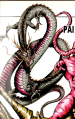 Artwork from Digital Devil Story: Megami Tensei II
 Artwork from Devil Children Black Book and Red Book
 Sprite from Digital Devil Story: Megami Tensei II
 Animated sprite from Digital Devil Story: Megami Tensei II
 Sprite from the Game Boy version of Last Bible II
 Sprite from the Game Boy Color version of Last Bible II
 Sprite from Last Bible III
 Sprite from Last Bible Special
 Sprite from Majin Tensei
 Sprite from the Game Boy Color version of Devil Children Black Book and Red Book and Devil Children White Book
 Sprite from the PlayStation version of Devil Children Black Book and Red Book
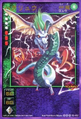 Card SC-002 from Shin Megami Tensei Devil Children Card Game: Maden Fukkatsu


