Gorgon

|
This demon page is a stub. You can help Megami Tensei Wiki by expanding it. |
| No reason provided. |


Gorgon is a Demon in the Megami Tensei franchise.
Profile
Origin
.jpg)
The Gorgons[a] were hideous and fearful monsters in Greek mythology, first known to be mentioned in passing in Homer's Iliad and Odyssey. According to Hesiod's Theogony, they were children of Phorcys and Ceto, and they were three in number, consisting of Sthenno, Euryale, and Medusa. While Sthenno and Euryale were immortal, Medusa was not. Medusa would be decapitated by Perseus,[1] after which the Gorgons pursued him.[2] They have wings and serpentine hair, and no mortal can look upon them and still draw breath[3] as they will be turned to stone.[4]
In ancient Greece, the face of a Gorgon, called the gorgoneion, was a popular symbol thought to ward off evil.
Design
All of Gorgon's designs in Megami Tensei franchise have the lower half of a serpent, contrary to the classical depictions of Gorgons with human legs. The depiction of Medusa—and by extension the Gorgons—as half-serpent can be found in various works since the 1980s and was popularized by the 1981 British–American film Clash of the Titans.[5]
Gameplay
- For complete gameplay information, see Gameplay:Gorgon.
Compendium

|
This section has content in need of translation. |
| The content in this section is missing a translation. You can help Megami Tensei Wiki by adding one. |
| Compendium Entries | |
|---|---|
| Shin Megami Tensei(A-Mode DDS) |
Origin: Greece |
| Shin Megami Tensei II(A-Mode DDS) |
出身地:ギリシア ギリシア神話に登場する三姉妹の妖女の総称。長女、「強い女」ステンノー、次女「遠くまで飛ぶ女」エウリュアレー三女、「支配する女」メデューサの三人を示す。アテナの神殿で海神ポセイドンと不義を働いた為、アテナにより、髪の毛は蛇、猪の牙と青銅の腕を持つ醜い怪物に変えられた。末妹のメデューサだけ不死の肉体を持っていなかった為、アテナとヘルメスの加護を受けた英雄ぺルセウスによって討たれた。Translation: |
| Shin Megami Tensei: Imagine |
ギリシア神話に登場するポルキュスとケトの間に生まれた3姉妹の妖女の総称。 3姉妹は長女ステンノー、次女エウリュアレー、三女メデューサと名前が付けられている。 元は美しい娘であったが、三女メデューサが海神ポセイドンと女神アテナの神殿で交わった為、 それに怒ったアテナがメデューサを醜く変え、それに抗議した姉2人も同じように醜く変えてしまった。 この時、讃えられるほど美しい髪の毛も1本1本を蛇に変えられた。 また、長女と次女は不死だが、三女のメデューサのみは不死ではない。 アテナの怒りはメデューサら3姉妹を醜く変えただけでは収まらず、 ペルセウスがメデューサを退治しようとした際に彼を援助した。Translation: The three sisters are named Sthenno (the eldest), Euryale (the second), and Medusa (the third). Originally, they were beautiful maidens, but when the third sister Medusa had an affair with the sea goddess Poseidon in the temple of the goddess Athena, Athena became angry and changed Medusa into an ugly woman, which made her and her two sisters ugly as well. At this time, even their hair, which was so beautiful that it was praised, was turned one by one into serpents. In addition, the eldest and second daughters are immortal, but only the third daughter, Medusa, is not.Athena's anger did not stop with the disfigurement of Medusa and the other three sisters; she assisted Perseus in his attempt to exterminate Medusa. |
| Persona 4 |
A hideous female monster with poison fangs and snakes instead of hair. Her name is Greek for "terrible." After Perseus took her head, he offered it to the gods who helped him slay her. |
| Persona 4 Golden | |
| Persona Q: Shadow of the Labyrinth |
A hideous female monster with poison fangs and snakes instead of hair. Her name is Greek for "terrible." After Perseus took her head, he offered it to the gods who helped him slay her. |
| Persona Q2: New Cinema Labyrinth |
A hideous female monster with poison fangs and snakes instead of hair, her name is Greek for "terrible." After Perseus took her head, he offered it to the gods who helped him slay her. |
Nomenclature
| Language | Name | Meaning |
|---|---|---|
 English English
|
Gorgon | |
 Japanese Japanese
|
ゴルゴン Gorugon | Gorgon |
 Korean Korean
|
고르곤 Goreugon | Gorgon |
Gallery
-
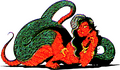 Artwork for Shin Megami Tensei from Shin Megami Tensei Hisshō Kōryaku-hō
 -
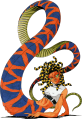 Artwork from Shin Megami Tensei II
 -
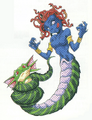 Artwork of Gorgon and Heqet from Last Bible III
 -
 Artwork from Persona 4
 -
 Sprite from Digital Devil Story: Megami Tensei
 -
 Sprite from the Super Famicom version of Shin Megami Tensei
 -
 Sprite from the Mega-CD version of Shin Megami Tensei
 -
 Sprite from the PlayStation version of Shin Megami Tensei
 -
 Sprite from the PlayStation version of Shin Megami Tensei II
 -
 Sprite from the PlayStation version of Shin Megami Tensei if...
 -
 Sprite from the Game Boy version of Last Bible
 -
 Sprite from the Game Boy Color version of Last Bible
 -
 Sprite from the Game Gear version of Last Bible
 -
 Sprite from the Game Boy version of Last Bible II
 -
 Sprite from the Game Boy Color version of Last Bible II
 -
 Sprite from Last Bible III
 -
 Sprite from Last Bible Special
 -
 Sprite from Shinyaku Last Bible
 -
 Sprite from Shinyaku Last Bible II: Hajimari no Fukuin
 -
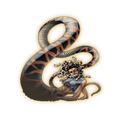 Card graphic from Persona 4
 -
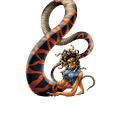 Graphic from Persona 4 Golden
 -
 Graphic from Persona Q: Shadow of the Labyrinth
 -
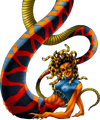 Graphic from Persona Q2: New Cinema Labyrinth
 -
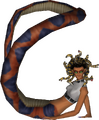 Model from Persona 4


Notes
References
- ↑ Theogony 274-281, Hesiod. Greek.
- ↑ Shield of Heracles 216-236, Pseudo-Hesiod. Greek.
- ↑ Prometheus Bound 798-800, Aeschylus. Greek.
- ↑ Bibliotheca 2.4.2, Apollodorus. Greek.
- ↑ Phil Boot, The legacy of Ray Harryhausen’s Medusa. Published August 22, 2013. Retrieved September 3, 2025. Science and Media Museum.
- Stubs
- Demon Stubs
- Pages needing translations
- Demons from Greek Culture
- Demons in Digital Devil Story: Megami Tensei (Game)
- Demons in Kyūyaku Megami Tensei
- Demons in Shin Megami Tensei (Game)
- Demons in Shin Megami Tensei II
- Demons in Shin Megami Tensei if...
- Demons in Giten Megami Tensei: Tokyo Revelation
- Demons in Shin Megami Tensei: Imagine
- Demons in Shin Megami Tensei if...: Hazama Hen
- Demons in Shin Megami Tensei: 20XX
- Demons in Shin Megami Tensei: Devil Colosseum 20XX
- Demons in Shin Megami Tensei: Tokyo Requiem
- Beasts in Last Bible (Game)
- Beasts in Last Bible II
- Beasts in Last Bible III
- Beasts in Last Bible Special
- Beasts in Shinyaku Last Bible
- Beasts in Shinyaku Last Bible II: Hajimari no Fukuin
- Personas in Persona 4
- Personas in Persona 4 Golden
- Personas in Persona Q: Shadow of the Labyrinth
- Personas in Persona Q2: New Cinema Labyrinth
- Demons in Digital Devil Saga: Avatar Tuner
- Demons in Digital Devil Saga: Avatar Tuner 2