Ryūtarō Itō

|
This article is in need of image(s). You can help Megami Tensei Wiki by uploading one. |
| No reason provided. |
| Ryūtarō Itō | |
| 伊藤 龍太郎 | |

Itō in 2021 | |
| Date of Birth | July 28, 1964[1] |
| Birthplace | Iwata, Shizuoka Prefecture[1] |
| Other Name(s) | Ryutaroh Itoh Ryutarou Itou R. Ito  Shin Megami Tensei (Super CD-ROM²) Shin Megami Tensei (Super CD-ROM²) |
| Nationality | Japanese |
| Occupation(s) | Writer |
| Known For | Shin Megami Tensei series |
Ryūtarō Itō (伊藤 龍太郎, Itō Ryūtarō), is a person involved with the Megami Tensei franchise. He worked on the scenario, setting, and dialogue for the early Shin Megami Tensei series titles, along with Shin Megami Tensei: Devil Summoner.
Biography

|
This section is a stub. You can help Megami Tensei Wiki by expanding it. |
| No reason provided. |
Early Life
Ryūtarō Itō was born on July 28, 1964, in Iwata, Shizuoka Prefecture, Japan.[1]
Career
Ryūtarō Itō began his career in the gaming industry while working part-time at AD TECHNOS,[a] a company known for producing board games.[2] He later wrote articles on simulation games for the niche magazine SIMULATOR, where he met editor-in-chief Ginichiro Suzuki, the father of Kazunari Suzuki, who recommended him to Atlus, the studio behind the Megami Tensei series. At the time, Itō was unfamiliar with Atlus and the franchise.[3]
After his interview at Atlus, Itō was hired. Initially a part-time employee, he was required to commute reliably for two consecutive weeks to secure a full-time position.[4] He subsequently began working on game testing for King of Kings and Battle Fleet, both simulation titles published by Namco.[5]
Itō later contributed to Digital Devil Story: Megami Tensei II for the Famicom, writing scenario content, including character dialogue and 3D map design. He was credited with elements such as the sarcastic shopkeeper dialogue and a scene in which the protagonist loses an arm.[6] He also included a closing credit referencing the original novels’ protagonist.[7]
He continued as a scenario writer on the Super Famicom titles Shin Megami Tensei, Shin Megami Tensei II, and the spin-off Shin Megami Tensei if..., for which he wrote the lyrics to the Karukozaka High School anthem, drawing inspiration from the school song of his alma mater.[8] For Shin Megami Tensei, he was responsible for the original story concept and primarily focused on the Chaos Hero-related scenarios.[9][10] He also contributed to Shin Megami Tensei: Devil Summoner for the Sega Saturn.
Following his tenure at Atlus, Itō became a senior producer at Smart System Co., Ltd., where he continues to work.
Personal Life
Media Credits
This is a list of each Megami Tensei media Ryūtarō Itō was involved with.
| Year | Game | Role(s) |
|---|---|---|
| 1990 | Digital Devil Story: Megami Tensei II (FC) | Scenario 3D Map Design NPC Dialogue |
| 1992 | Shin Megami Tensei (SFC) | Planning |
| 1993 | Shin Megami Tensei (Super CD-ROM²) | Special Thanks |
| 1994 | Shin Megami Tensei (Mega-CD) | |
| Shin Megami Tensei II (SFC) | Planner | |
| Shin Megami Tensei if... (SFC) | ||
| 1995 | Shin Megami Tensei: Devil Summoner (SFC) |
Gallery
-
 Artwork of Ryūtarō Itō depicted as Chaos Hero in the Shin Megami Tensei Law & Chaos Disc booklet
 -
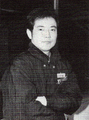 Photo from Shin Megami Tensei Nendai-ki


Notes
References
- ↑ 1.0 1.1 1.2 Shin Megami Tensei if... Official Guidebook Kaimei-hen. 120. ISBN-13: 978-4893663115.
- ↑ "Ryūtarō Itō: Just before joining Atlus, I actually worked part-time during my student years at a company named AD TECHNOS which made board games." Game Shokunin Dai 1: Shūdakara Nihon no Gēmu wa Omoshiroi. Published by Micro Magazine. Translation by Blue Forest Bible.
- ↑ "Ryūtarō Itō: After that job, I moved on to write for a niche magazine named SIMULATOR which exclusively covered simulation games. It just so happened that the editor-in-chief here was Ginichiro Suzuki who one day suggested I try working for the company that employed his son, Atlus. At the time I didn’t even know Atlus made NES games, never mind Megami Tensei." Game Shokunin Dai 1: Shūdakara Nihon no Gēmu wa Omoshiroi. Published by Micro Magazine. Translation by Blue Forest Bible.
- ↑ "So you got the job at Atlus thanks to meeting Ginichiro then.
Ryūtarō Itō: That’s correct. However, I was pretty strapped for cash at the time so when I went for the interview, I only had enough train fare to cover a one-way journey. Luckily I started working for Atlus the day after my interview, but I wound up having to ask, much to my embarrassment, if the interviewer could lend me ¥50,000. (laughs) What’s more, I frequently showed up late for work, which obviously didn’t go down too well with the company. Then, one day, I was told “If you manage to be on time for 2 weeks straight, we’ll give you the job full time. But if you’re late even once during this period, you’re fired!” By this time I had become fairly adept at being late, but the chance of ending my time as a part-timer was too good to pass up. It was all going smoothly until the final day of those two weeks when I slept in but somehow made it to work in time by catching a cab." Game Shokunin Dai 1: Shūdakara Nihon no Gēmu wa Omoshiroi. Published by Micro Magazine. Translation by Blue Forest Bible. - ↑ "What was your first job upon joining Atlus?
Ryūtarō Itō: I was a game tester for King of Kings and Battle Fleet. I ended up working on these projects as they needed someone familiar with simulation games to test out the two titles." Game Shokunin Dai 1: Shūdakara Nihon no Gēmu wa Omoshiroi. Published by Micro Magazine. Translation by Blue Forest Bible. - ↑ "The scene in which the protagonist has their arm bitten off was incredibly shocking. I still remember being convinced I’d made some kind of fatal error.
Ryūtarō Itō: I’m fairly confident in saying that no other game had a scene in it like this. I myself was keenly aware of just how grotesque it was. I certainly don’t think you’d see anything like it in modern games now that the graphics have progressed so far." Game Shokunin Dai 1: Shūdakara Nihon no Gēmu wa Omoshiroi. Published by Micro Magazine. Translation by Blue Forest Bible. - ↑ "you’re greeted with the message “PROGRAMMED by A.NAKAJIMA”. Was this an homage to the original game?
Ryūtarō Itō: I basically just put it to get a smile out of anyone who was familiar with the Aya Nishitani novel." Game Shokunin Dai 1: Shūdakara Nihon no Gēmu wa Omoshiroi. Published by Micro Magazine. Translation by Blue Forest Bible. - ↑ "You were the one who penned the lyrics for the Keikozaka High School school song that plays during the game’s climax, correct?
Ryūtarō Itō: I did. You only hear the first verse’s lyrics in the game, but I actually wrote three verses. When I first asked Mr. Masuko to add the lyrics to the music, he looked distinctly unimpressed. (laughs) One interesting fact, I actually used some of the lyrics from my own school’s school song for the game." Game Shokunin Dai 1: Shūdakara Nihon no Gēmu wa Omoshiroi. Published by Micro Magazine. Translation by Blue Forest Bible. - ↑ "「魔界水滸伝」をまったく読んでないアトラスのシナリオ担当の伊藤氏が、提案してきたシナリオ原案と、偶然にも同じだったのである。" Translation: "It was a complete coincidence that the original story concept proposed by Mr. Ito, the scenario writer at Atlus, was identical to Makai Suikoden, even though he had never read it." "悪魔使い・デミアン鈴木の魔界資料館", Shin Megami Tensei Fanbook: Club Jakyō no Yakata. Published by Takarajimasha. Japanese. 79.
- ↑ "伊藤さんには、カオスヒーロー系のシナリオを中心にやってもらってましたね。" Translation: "Mr. Ito mainly worked on the Chaos Hero-related scenarios." Kazunari Suzuki, [1]. Retrieved September 3, 2025. X.