Qiongqi

|
This Devil Children series demon page is a stub. You can help Megami Tensei Wiki by expanding it. |
| No reason provided. |
| Qiongqi | |
| キュウキKyūki | |

Artwork from Devil Children Black Book and Red Book | |
| Other Name(s) | Kyuki DemiKids Light Version and Dark Version DemiKids Light Version and Dark Version |
| Origin | Chinese culture |
| Race(s) | Specter |
Qiongqi is a Demon in the Megami Tensei franchise.
Profile
Origin
Qiongqi[a] is among the Four Perils[b] in Chinese mythology, mentioned prominently in the Classic of Mountains and Seas,[c][1] Zuo Zhuan's[d] commentary of the Spring and Autumn Annals,[e] and the Book of Gods and Strange Things.[f] Within the Classic of Mountains and Seas, Qiongqi is described as living on the summit of Jian Mountain,[g] where it is shown to be a man-eating beast that looks like an ox, sounds like a wild dog, and has hedgehog quills.[2] However, another description states that it is a winged tiger that can understand human speech and action; it eats all kinds of things.[3] As one of the Four Perils, Qiongqi is in league with Hundun, Taotie, and Taowu, and stands in opposition to the Four Symbols.
Along with Taowu, it is used as a moral lesson in Youxue Qionglin: Taowu represents cruelty, Qiongqi represents brutality.[4]
In Records of the Grand Historian, Qiongqi is considered a symbol of Shaohao's[h] troublesome child, who was devoid of ability, despised loyalty and good faith, and embraced and promoted evil words. Shaohao himself is said to have been the son of the Yellow Emperor, though this is considered controversial. Emperor Shun[i] banished Shaohao's failed child along with three other individuals after much controversy.[5] In this sense, Qiongqi is also considered one of the Four Criminals.[j][6]
Design
Qiongqi's appearance matches the description shown in the Classic of Mountains and Seas.
Gameplay

|
This gameplay section is a stub. You can help Megami Tensei Wiki by expanding it. |
| No reason provided. |
Compendium

|
This section has content in need of translation. |
| The content in this section is missing a translation. You can help Megami Tensei Wiki by adding one. |
| Compendium Entries | |
|---|---|
| Devil Children Black Book and Red Book | GBC: わるいデビルに みかたする きょうぼうなトラ そらをとんで どこからともなく やってくるPS: 悪いデビルに 味方する きょうぼうなトラ 空をとんで どこからともなく やって来るTranslation: |
| Devil Children White Book | わるいデビルに みかたする きょうぼうなトラ そらをとんで どこからともなく やってくるTranslation: |
| Devil Children Light Book and Dark Book | 悪いデビルに味方する キョウボウな トラの デビル 空を 飛んで どこからともなく やってくるTranslation: A ferocious tiger Devil in league with the bad Devils. It flies through the sky and shows up out of nowhere. |
| DemiKids Light Version and Dark Version |
Winged tiger-demon that appears from out of the sky to swoop down on its enemies. |
| Devil Children Fire Book and Ice Book | 悪いデビルに味方する キョウボウな トラの デビル 空を 飛んで どこからともなく やってくるTranslation: A ferocious tiger Devil in league with the bad Devils. It flies through the sky and shows up out of nowhere. |
Nomenclature
| Language | Name | Meaning |
|---|---|---|
 English English
|
KyukiDemiKids Light Version and Dark Version | |
 Japanese Japanese
|
キュウキ Kyūki | Kyūki, Japanese reading of 窮奇 Qióngqí (distressingly strange) |
Gallery
-
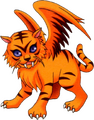 Artwork from Devil Children Black Book and Red Book
 -
 Sprite from Last Bible III
 -
 Sprite from the Game Boy Color version of Devil Children Black Book and Red Book and Devil Children White Book
 -
 Sprite from the PlayStation version of Devil Children Black Book and Red Book
 -

-
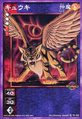 Card TC-023 from Shin Megami Tensei Devil Children Card Game: Maden Fukkatsu


Notes
- ↑ Simplified Chinese: 穷奇, Traditional Chinese: 窮奇, romanized Qióngqí
- ↑ Chinese: 四凶, romanized Sì Xiōng
- ↑ Simplified Chinese: 山海经, Traditional Chinese: 山海經, romanized Shānhǎijīng
- ↑ Simplified Chinese: 左传, Traditional Chinese: 左傳, romanized Zuǒ Zhuàn
- ↑ Chinese: 春秋, romanized Chūnqiū
- ↑ Simplified Chinese: 神异经, Traditional Chinese: 神異經, romanized Shényìjīng
- ↑ Simplified Chinese: 邽山, Traditional Chinese: 邽山, romanized Jiān Shān
- ↑ Simplified Chinese: 少暤, Traditional Chinese: 少暤, romanized Shǎohào
- ↑ Simplified Chinese: 帝舜, Traditional Chinese: 帝舜, romanized Dì Shùn
- ↑ Simplified Chinese: 四罪, Traditional Chinese: 四罪, romanized Sì Zuì
References
- ↑ Zhongquan, Miao, ed. 2018. 山海经 [Shānhǎijīng]. Simplified Chinese ed. Shenyang: 万卷出版公司 [Wanjuan Publishing Company].
- ↑ 《山海经》:又西二百六十里,曰邽山。其上有兽焉,其状如牛,猬毛,名曰穷奇,音如獋狗,是食人。蒙水出焉,南流注于洋水,其中多黄贝,蠃鱼,鱼身而鸟翼,音如鸳鸯,见则其邑大水。
- ↑ 《山海经》:"西北有獸焉,狀似虎,有翼能飛,便剿食人。知人言語,聞人鬥,輒食直者;聞人忠信,輒食其鼻;聞人惡逆不善,輒殺獸往饋之。名曰窮奇,亦食諸禽獸也。"
- ↑ Cheng, D.J. et al. (2023). 幼学琼林 [Yòuxué Qiónglín] in 幼学琼林三百千 [Yòuxué Qiónglín Sānbǎiqiān]. 万卷出版社 [Wanjuan Publishing House]. Quote: 人之狠恶,同于梼杌;人之凶暴,类如穷奇。
- ↑ Qian, Sima. 五帝本纪 in 史记. https://ctext.org/shiji/wu-di-ben-ji/ens?searchu=%E7%BC%99%E4%BA%91%E6%B0%8F%E6%9C%89%E4%B8%8D%E6%89%8D%E5%AD%90&searchmode=showall#n4498 In ancient days the Emperor Hong (Huangdi) had a son devoid of ability, who shut himself off from duty, and was a villain in secret, delighting in the practice of the worst vices, and all men called him Hundun (Chaos). (The Emperor) Shaohao had a descendant devoid of ability, who overthrew good faith, hated loyalty, extolled specious and evil talk, and all the people called him Qiongji (Monster). Zhuanxu had a son devoid of ability, who would receive no instruction and acknowledge no good words, and all the people called him Taowu (Block). These three men everyone was distressed about until the time of Yao, but Yao could not send them away. Jinyun had a son devoid of ability, who was greedy in eating and drinking, and pursued wealth blindly. All the people called him Taotie (Glutton), hated and compared him to the three other wicked men. Shun received visitors at the four gates, but banished these four wicked ones to the four borders of the empire to manage hobgoblins; and those at the four gates rightly said there were no wicked men among them.
- ↑ 《尚书-舜典》:象以典刑,流宥五刑,鞭作官刑,扑作教刑,金作赎刑。眚灾肆赦,怙终贼刑。钦哉,钦哉,惟刑之恤哉!流共工于幽洲,放驩兜于崇山,窜三苗于三危,殛鲧于羽山,四罪而天下咸服。
- Stubs
- Devil Children Stubs
- Demon Stubs
- Pages with section stubs
- Pages with gameplay section stubs
- Pages needing translations
- Demons from Chinese Culture
- Beasts in Last Bible III
- Demons in Devil Children Black Book and Red Book
- Demons in Devil Children White Book
- Demons in Devil Children Light Book and Dark Book
- Demons in Devil Children Fire Book and Ice Book
- Demons in Devil Children: Messiah Riser