| Himiko
|
| ヒミコ
|
|
|
| Origin
|
Japanese history
|
| Arcana
|
Lovers
|
Himiko is a Persona in Persona 4. It is the Initial Persona of Rise Kujikawa.
Profile
Origin

|
This origin section is a stub. You can help Megami Tensei Wiki by expanding it.
|
| No reason provided.
|
Himiko,[a] or Pimiko in Old Japanese, was a shaman-queen mentioned in ancient Chinese historical documents as a ruler of Yamatai, a kingdom in Wa (Japan) circa the 2nd and 3rd centuries AD.
Design
In Persona 4, Himiko's antenna is a modern interpretation of the magic she used to rule throughout the land, and the honeycomb patterns on her antenna was inspired by an old ritual where the cracks on burnt turtle shells were used for fortune telling. Being a non-combat Persona, she is dressed in impractical clothing, and only functions when Rise wears her crown as a pair of goggles.[1]
In Arena Ultimax, Himiko evolves and gains four floating bits that resemble her antenna which are used in matches offensively to shoot projectiles and defensively to generate shields.
Gameplay
In Persona 4, Rise starts with Himiko. It transcends into Kanzeon upon maxing her Social Link.
In Golden, Rise starts with Himiko. It transcends into Kanzeon upon maxing her Social Link, and can further transcend into Kouzeon during winter.
- Main article: Gameplay:Rise Kujikawa § Persona 4 Arena Ultimax
Rise uses a new version of Himiko as her Persona for her C and D buttons in Arena Ultimax.
|
|
This section is a stub. You can help Megami Tensei Wiki by expanding it.
|
| No reason provided.
|
|
|
|
|
|
|
| Resistances
|

|

|

|

|

|

|

|

|

|
| —
|
—
|
—
|
—
|
—
|
—
|
—
|
—
|
—
|
|
| Skills
|
| Skill
|
Cost
|
Description
|
Level
|
|
|
|
This section is a stub. You can help Megami Tensei Wiki by expanding it.
|
| No reason provided.
|
|
|
|
|
|
|
| Resistances
|

|

|

|

|

|

|

|

|

|
| —
|
—
|
—
|
—
|
—
|
—
|
—
|
—
|
—
|
|
| Skills
|
| Skill
|
Cost
|
Description
|
Level
|
|
| Unison Skills
|
| Skill
|
Cost
|
Description
|
|
Game Appearances
|
|
This section is a stub. You can help Megami Tensei Wiki by expanding it.
|
| No reason provided.
|
In Episode P4, Himiko takes on a new form and evolves to be combat capable.
|
|
This section is a stub. You can help Megami Tensei Wiki by expanding it.
|
| No reason provided.
|
Manual
| Manual Descriptions
|
| Persona 4
|
A shamaness and queen of the ancient kingdom of Yamatai, elected by virtue of her impressive magical powers. The only record of her reign is from a diplomatic envoy to China in the third century A.D., and scholars continue to dispute the location of her kingdom to this day.
|
Nomenclature
Himiko is the modern Japanese pronunciation of a reconstructed Old Japanese *Pimiko or *Pimeko. The name is attested only in Chinese sources, where it was written phonetically; contemporary Chinese pronunciation is reconstructed as *pjie̯-mjie̯-χuo.[2][b]
A common suggestion for the name Pimiko's meaning is that it may be a compound of Old Japanese 姫 pime (a laudatory title for women) and 子 ko ("child"). However, Miller (1967) notes that this compound is unknown in Old Japanese texts, and the final syllable being a transcription of ko is dubious due to the use of the consonant χ; this element is transcribed elsewhere with the expected k.[2]
Names in Other Languages
| Language |
Name |
Meaning
|
 English English
|
Himiko
|
 Japanese Japanese
|
ヒミコ Himiko
|
Gallery
-
Himiko on the cover of the Vol. 6 Japanese Standard Edition DVD of
Persona 4 The Animation
-
Himiko on the jacket cover of the Japanese Vol. 6 Full Disc of Persona 4 The Animation
-
-
-
Concept artwork for Persona 4
-
Render from Persona 4 The Animation
-
Card graphic from Persona 4
-
-
-
-
Model from Persona 4
-
Model of Himiko playing a harp from
Persona 4: Dancing All Night
Notes
- ↑ Japanese: 卑弥呼, romanized Himiko; Simplified Chinese: 卑弥呼, Traditional Chinese: 卑彌呼, romanized Bēimíhū
- ↑ ⟨j⟩ represents a palatal approximant (usually spelled in English as ⟨y⟩), and ⟨χ⟩ represents a velar fricative (represented in Hanyu Pinyin as ⟨h⟩).
References
- ↑ "Characters: Rise Kujikawa", Persona 4 Official Design Works, Atlus, Famitsu Editorial Department. Published by Famitsu (2008). Japanese. p. 95. ISBN-13: 978-4757745087.
- ↑ 2.0 2.1 The Japanese Language (1967), Roy Andrew Miller. Published by The University of Chicago Press. p. 22.


 Himiko on the cover of the Vol. 6 Japanese Standard Edition DVD of Persona 4 The Animation
 Himiko on the jacket cover of the Japanese Vol. 6 Full Disc of Persona 4 The Animation
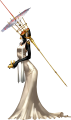 Artwork from Persona 4
 Artwork from Persona 4 Arena Ultimax
 Concept artwork for Persona 4
 Render from Persona 4 The Animation
 Card graphic from Persona 4
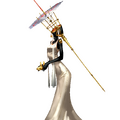 Graphic from Persona 4 Golden
 Graphic from Persona Q: Shadow of the Labyrinth
 Graphic from Persona Q2: New Cinema Labyrinth
 Model from Persona 4
 Model of Himiko playing a harp from Persona 4: Dancing All Night


