
|
This demon page is a stub. You can help Megami Tensei Wiki by expanding it.
|
| No reason provided.
|
Cailleach Bhearra is a Demon in the Megami Tensei franchise.
Profile
Origin

|
This section is a stub. You can help Megami Tensei Wiki by expanding it.
|
| Reason: Needs info from Scottish folklore and not just Irish
|
The Cailleach Bhéarra[a] (meaning "old woman of Beare") is an old woman in Irish and Scottish folklore.[2]
In Irish folklore, she is said to have had fifty foster-children and to have lived seven periods of youth, and all men who lived with her died of old age.[3][1][4] A poem written at some point from the 9th[2] to the 11th[1] century depicts her lamenting over her old age, comparing it unfavorably with her youth,[1][4] when she was apparently a courtesan.[4] The large stone cairns near Oldcastle in Meath were said to have been dropped from the Cailleach Bhéarra's apron.[5]
Scottish folklorist Donald Alexander MacKenzie records in his book Wonder Tales from Scottish Myth and Legend stories of a figure known as Beira, whom he calls the "Queen of Winter". While the demon is named for the figure in Irish folklore, official profiles are based on Mackenzie's Beira.
Design
|
|
This design section is a stub. You can help Megami Tensei Wiki by expanding it.
|
| No reason provided.
|
Gameplay
Compendium
| Compendium Entries
|
| Shin Megami Tensei II(A-Mode DDS)
|
出身地:スコットランド
スコットランド高地の冬の精霊。名は「青い婆さん」の意味を持つ。青白い顔をした老婆の姿をしている。彼女が持つ冬枯れの杖は、打つと木々の葉は落ち、草は枯れ、新しい芽は出なくなるといわれている。また、野生動物の守護者でもある五月一日の五月祭により春が祝われると、杖を柊の木の下に投げ込み、灰色の石に変身してしまう。十月三一日のハロウィンに、再び蘇り植物を枯らせ、雪を降らせて世界を冬に染めるといわれている。Translation: Place of origin: Scotland
A winter spirit of the Scottish Highlands. Her name carries the meaning of "blue old woman". She has the appearance of a pale-faced old woman. It is said she carries a staff which causes plants to decay in the winter; when struck, leaves fall from trees, grass withers, and new shoots stop sprouting. Additionally, she is the guardian of wild animals. However, when spring is celebrated on May Day on May 1, her staff is thrown under a holly tree and transforms into a gray stone. It is said that on Halloween on October 31, she comes to life once more, causing plants to dry up and causing snow to fall and plunge the world into winter.
|
Nomenclature
Names in Other Languages
| Language |
Name |
Meaning
|
 Japanese Japanese
|
カリアッハベーラ Kariahha bēra |
Cailleach Bhéarra
|
Gallery
Notes
References
- ↑ 1.0 1.1 1.2 1.3 "The Song of the Old Woman of Beare", Otia Merseiana (1899), Kuno Meyer. Published by G. E. Stechert. Vol. 1 pp. 119-128.
- ↑ 2.0 2.1 "a female divinity in Irish and Scottish Gaelic literature and oral tradition. The original pagan conception interacts with the more Christian sense of cailleach (‘nun’) in the 9th-cent. poem ‘Lament of the Old Woman of Beare’. She is represented as an ancient nun bemoaning her past youth, but a connection with the goddess of sovereignty is also vestigially present." The Concise Oxford Companion to Irish Literature (2000), Robert Welch. Published by Clarendon Press. ISBN-13: 978-0-19-172710-8. https://doi.org/10.1093/acref/9780192800800.001.0001
- ↑ "The old woman or nun of Beare", Vernam Hull. Zeitschrift für celtische Philologie, 19, pp. 174-176. Published 1933 by Max Niemeyer Verlag. https://doi.org/10.1515/zcph.1933.19.1.174
- ↑ 4.0 4.1 4.2 The Vision of MacConglinne (1892), Kuno Meyer. Published by David Nutt. pp. 208-210.
- ↑ The Vision of MacConglinne (1892), Kuno Meyer. Published by David Nutt. pp. 131-134.

 Shin Megami Tensei: 20XX


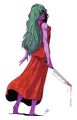 Artwork from Shin Megami Tensei II
 Sprite from the PlayStation version of Shin Megami Tensei II
 Sprite from the PlayStation version of Shin Megami Tensei if...