Kushiel is a Demon in the Megami Tensei franchise.
Profile
Origin
Kushiel is one of the Seven Angels of Punishment, along with Lahatiel, Shoftiel, Makatiel, Hutriel, Puriel, and Rogziel.[1] In one variant of the aggadah discussing Gehinnom (Hell) attributed to Rabbi Joshua ben Levi and included in Gershom Bader's The Jewish Spiritual Heroes, Kushiel is seen by Joshua beating, among those who sinned by not accepting the Torah, Absalom, son of King David, with fiery rods. Absalom was to be punished for having rebelled against his father. After Kushiel threw all but Absalom into fire, as it was about to punish him, a Bath-Kol[a] (divine voice) stayed its hand, for Absalom had descended from those from Mount Sinai; this was because those at Mount Sinai accepted the Torah without knowing what the Ten Commandments were going to be.[2] Therefore, Absalom was made to merely observe the punishment of the other sinners. Note that the Hebrew version of this aggadah included in Judah David Eisenstein's Ozar Midrashim mentions angels in the plural and does not give a name.[3]
Design

|
This design section is a stub. You can help Megami Tensei Wiki by expanding it.
|
| No reason provided.
|
Gameplay
|
|
| Name
|
Level
|
HP
|
MP
|
| Kushiel
|
52
|
588
|
277
|
|
|
|
|
|
|
| Attack
|
Accuracy
|
Defense
|
Evasion
|
M. Attack
|
M. Effect
|
| 140
|
99
|
120
|
97
|
21
|
16
|
|
| Moon Phase Damage Output
|
 New New
|
 1/8 1/8
|
 2/8 2/8
|
 3/8 3/8
|
 Half Half
|
 5/8 5/8
|
 6/8 6/8
|
 7/8 7/8
|
 Full Full
|
| 87.5% |
93.75% |
100% |
100% |
112.5% |
87.5% |
100% |
112.5% |
125%
|
|
| Basic Attack
|
Element
|
Hit(s)
|
Target
|
| Sword
|
2
|
Single enemy
|
|
| Magic Skills
|
| Skill
|
Attribute
|
Cost
|
Description
|
| Mabufula
|
Ice
|
11 MP
|
Strongly freezes all enemies and puts them into the Freeze state.
|
| Mahama
|
Light
|
10 MP
|
Causes all enemies to ascend to heaven with the power of exorcism.
|
| Tetra
|
Support
|
8 MP
|
Nullifies enemies' magic and extra attacks for 1 turn.
|
|
|
|
Game Appearances
Kushiel appears in the Sumaru Climax Theater scenario "The Persona Thief".
Compendium

|
This section has content in need of translation.
|
| The content in this section is missing a translation. You can help Megami Tensei Wiki by adding one.
|
| Compendium Entries
|
| Shin Megami Tensei II(A-Mode DDS)
|
出身地:イスラエル
処罰の七天使の一人である、破壊の天使。名は「厳しき神」を意味し、炎の鞭で神に背いた国家を罰する役目を持つとされている。Translation: Place of origin: Israel
|
Nomenclature
Names in Other Languages
| Language |
Name |
Meaning
|
 English English
|
Kushiel
|
 Japanese Japanese
|
クシエル Kushieru |
Kushiel
|
Gallery
Notes
- ↑ Hebrew: בַּת קוֹל, romanized baṯ qôl
References
- ↑ A Dictionary of Angels, Including The Fallen Angels (1967), Gustav Davidson. Published by Free Press. p. 41. ISBN-13: 9780029070505.
- ↑ Bader, Gershom. (1940). The Jewish Spiritual Heroes. New York: Sefaria. One nation says to another: ‘We have sinned in not accepting the Torah; what have you done?’ and the other nation replies: ‘We have committed the same sin that you have committed.’ Then they all turn to Absalom and ask: ‘What was your sin?’ and Absalom replies: ‘I have sinned against my father.’ An angel then beats them all with fiery rods and the name of the angel is Kushiel. He throws them into fire until they are burned and then they come out in their previous form. Finally the angel is ready to chastise Absalom, but a Bath Kol announces: ‘Do not beat him, for he is descended from a people which promised at Mount Sinai to obey God’s commandments before they even knew what these commandments would be.’” [1]
- ↑ Ozar Midrashim: A Library of Two Hundred Minor Midrashim, J. D. Eisenstein. Hebrew. Vol. I p. 213.


 Artwork from Shin Megami Tensei II
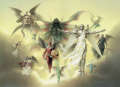 Cover artwork for Kazuma Kaneko Works II featuring Kushiel amongst other demons, titled "Advent"
 Sprite from the PlayStation version of Shin Megami Tensei II
 Sprite from the PlayStation Portable version of Persona 2: Innocent Sin
