Azael
| Azael | |
| アザエル | |

Artwork from Ronde | |
| Origin | Judaism |
Profile
Origin
Azael is a fallen angel figure who appears in Jewish texts, usually in conjunction with another fallen angel.
He first appears in the Book of Enoch as Asael,[a] who is one of the leaders of the Watchers, a group of fallen angels,[1] and one of the two most important along with Shemihaza.[2] It is said that he taught men to make swords.[3] In the Ethiopic version of Enoch, he is instead called Azazel, though he has a distinct name in the original Aramaic and in Greek.[3]
In later literature, he is referenced as Azael.[b] According to Yoma 67b of the Talmud, Uzza and Azael are a pair of sons of God that sinned with the daughters of men before the flood (Genesis 6:2). According to the school of Rabbi Yishmael, Azazel (in the rite of the scapegoat) was named for them.[4] These two are also elaborated upon in the Zohar and some midrashim.[5] Azael appears in a trio with Uzza and Azza in the Book of Palaces (3 Enoch). Additionally, Azael also appears with Shemhazai[5] or Shemhazael[6] (the same as Enoch's Shemihaza) in several other midrashim.
Design
Gameplay

|
This gameplay section is a stub. You can help Megami Tensei Wiki by expanding it. |
| No reason provided. |
Nomenclature
| Language | Name | Meaning |
|---|---|---|
 Japanese Japanese
|
アザエル Azaeru | Azael |
Gallery
-
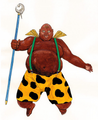 Artwork from Ronde
 -
 Sprite from Ronde

Notes
- ↑ Jewish Literary Aramaic: עשׂאל, romanized ʿAśaʾel; Greek: Ἀζαήλ, romanized Azaḗl
- ↑ Jewish Babylonian Aramaic: עַזָּאֵל, romanized ʿAzzāʾēl
References
- General
- The Books of Enoch: Aramaic Fragments of Qumrân Cave 4 (1976), J. T. Milik. Published by Clarendon Press. ISBN-13: 978-0-19-826161-2.
- Specific
- ↑ Milik 1976, p. 151.
- ↑ Milik 1976, p. 29.
- ↑ 3.0 3.1 Milik 1976, p. 159.
- ↑ Yoma 67b
- ↑ 5.0 5.1 Milik 1976, pp. 327-333.
- ↑ "On Neglected Hebrew Versions of Myths of the Two Fallen Angels", Moshe Idel. Entangled Religions, 13(6). Published March 24, 2022 by Center for Religious Studies. https://doi.org/10.46586/er.13.2022.9518