Bathin
| Bathin | |
| バシン | |

Artwork from Devil Children Black Book and Red Book | |
| Origin | Ars Goetia |
| Race(s) | Akuma |
Bathin is a Demon in the Devil Children series.
Profile
Origin
Bathin is a spirit in European demonology first attested as Machin, the 15th spirit in the Livre des esperitz, where he is said to be a great duke in the form of a strong man. He teaches the power of herbs and precious stones, and carries the master to wherever they desire. He has 37 legions under his command.[1]
Bathin is elaborated upon as Bathym, the 10th spirit in Johann Weyer's Pseudomonarchia Daemonum, which draws from earlier sources. Bathym, also known as Marthim, is a great and strong duke in the form of a strong man with a serpent's tail. He rides upon a pale horse and is knowledgeable of the powers of herbs and precious stones, and he can most swiftly carry a person from region to region. He has 30 legions under his command.[2]
In the Ars Goetia section of The Lesser Key of Solomon, which is heavily based on the Pseudomonarchia Daemonum, Bathin is said to be the 18th spirit summoned by King Solomon of Israel.[3]
Design
Bathin appears as a humanoid figure with a red, pointed, demon-like tail. He is dressed in dark attire and white gloves, and rides a red skull with green horns, with smoke coming out of its mouth.
Gameplay

|
This gameplay section is a stub. You can help Megami Tensei Wiki by expanding it. |
| No reason provided. |
Compendium

|
This section has content in need of translation. |
| The content in this section is missing a translation. You can help Megami Tensei Wiki by adding one. |
| Compendium Entries | |
|---|---|
| Devil Children Black Book and Red Book | GBC: あかいガイコツ がたののりものに のってとぶように はしるデビル ときには ひとを のせることもあるPS: 赤いガイコツ がたの乗り物に 乗ってとぶように 走るデビル 時には人を 乗せる事もあるTranslation: |
| Devil Children White Book | あかいガイコツ がたののりものに のってとぶように はしるデビル ときには ひとを のせることもあるTranslation: |
Nomenclature
| Language | Name | Meaning |
|---|---|---|
 Japanese Japanese
|
バシン Bashin | Bathin |
Gallery
-
 Artwork from Devil Children Black Book and Red Book
 -
 Sprite from the Game Boy Color version of Devil Children Black Book and Red Book
 -
 Sprite from the PlayStation version of Devil Children Black Book and Red Book
 -
 Sprite from Devil Children White Book
 -
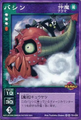 Card TD-028 from Shin Megami Tensei Devil Children Card Game: Messiah Kakusei


References
- ↑ "Demonological who's who of the 16th century and their medieval ancestors", Jean-Patrice Boudet. Médiévales, 44, pp. 117-140. Published Spring 2003 by Presses Universitaires de Vincennes. French. https://doi.org/10.4000/medievales.1019
- ↑ The Lesser Key of Solomon: Lemegeton Clavicula Salomonis (2001), Joseph H. Peterson (editor). Published by Weiser Books. p. 243. ISBN-13: 978-1-57863-220-6.
- ↑ The Lesser Key of Solomon: Lemegeton Clavicula Salomonis (2001), Joseph H. Peterson (editor). Published by Weiser Books. p. 14. ISBN-13: 978-1-57863-220-6.