Shadow

A Shadow is a concept in the Persona series. Shadows are the counterpart of Personas, created from human emotions. Sometimes a person's Shadow can appear, which are twisted manifestations of ones thoughts or feelings in the form of a facsimile to the original person.
Profile
Origin
Shadows are derived from Jungian psychology.
Design
Shadows are designed based on people's anxieties regarding their self-image.[1] Each of the Shadows is based on the motifs of the reversed Arcana.[2]
Gameplay
Shadows are the typical enemy in Persona series, except in Megami Ibunroku Persona and the Persona 2 duology, which instead feature demons. In Persona 3, Persona 4, and their various spinoff games, Shadows are all original designs that are not similar to demons, having a mask motif. Persona 3
Persona 4
Persona 3 FES
Persona 3 Portable
Persona Q: Shadow of the Labyrinth
Persona Q2: New Cinema Labyrinth
Persona 4: Dancing All Night
When battling against these Shadows, they take a form inspired by the arcana that the number on their masks correlate to. In Persona 5, Shadows manifest similarly to Shadows as they appear in other games, but upon starting a battle their true form as a demon is revealed. In Persona 5: The Phantom X, both type of shadow type of shadow design exist, the Shadows in Mementos manifest similar to demons while the Shadows in Tartarus manifest in the original designs from Persona 3.
- For a list of Shadows in Persona 3 and its remakes, visit Shadows in Persona 3.
- For a list of Shadows in Persona 4, visit Shadows in Persona 4.
- For a list of Shadows in Persona 4 Golden, visit Shadows in Persona 4 Golden.
- For a list of Shadows in Persona 5, visit Personas in Persona 5.
- For a list of Shadows in Persona 5 Royal, visit Personas in Persona 5 Royal.
- For a list of Shadows in Persona 5: The Phantom X, visit Shadows in Persona 5: The Phantom X.
- For a list of Shadows in Persona Q: Shadow of the Labyrinth, visit Shadows in Persona Q: Shadow of the Labyrinth.
- For a list of Shadows in Persona Q2: New Cinema Labyrinth, visit Shadows in Persona Q2: New Cinema Labyrinth.
Overworld Properties
- See also: Demon Symbol
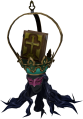
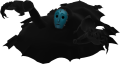
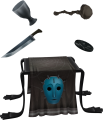
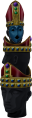
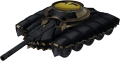
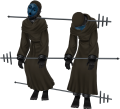
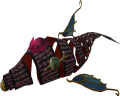
Standard Shadow
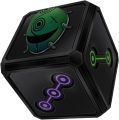
The most common Shadow to encounter. In Persona 3 and Persona 4, its size depends on how many in-battle Shadows it contains, with less in-battle Shadows resulting in a smaller model and vice versa. If the player is at a much greater level than the in-battle Shadows, the will flee. In Persona 3, it has a detection radius of 270° around its body, with a blind spot on its backside. In Persona 4, there are both floating Shadows and ground Shadows. Floating Shadows move slower than ground Shadows, but pursue the party for longer. In Persona 4 Golden, all of the the floating Shadows were removed.
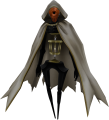
Strong Shadow

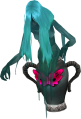
Shadows containing extremely powerful enemies. It glows bright red and contains in-battle Shadows that are found within standard overworld Shadows on later floors of whatever dungeon it's found in. Like the standard Shadow, in Persona 3 it has a detection radius of 270° around its body, with a blind spot on its backside.
Rare Shadow
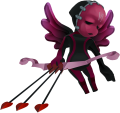
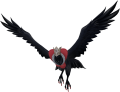
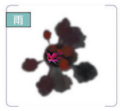
Shadows that contain rare enemies such as Wealth Hand or Opulent Hand in Persona 3 or Persona 4, and Treasure Demons in Persona 5. In Persona 3, they are represented with a small standard Shadow model colored gold, in Persona 4 they are represented with a floating gold Shadow, in Persona 3 Reload and Persona 4 Golden they are represented by a Wealth Hand, and in Persona 5 they are represented with a glowing gem. In Persona 3 and Persona 4, these shadows will always flee from the player when approached. In Persona 5, their gems will remain stationary and must be interacted with to begin battle. In Persona 3, it has a detection radius of 300° around its body, with a blind spot on its backside.
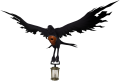
The Reaper
- Main article: The Reaper
The most powerful Shadow. In Persona 3 and Persona 5, The Reaper will appear after the player has spent too much time on any one floor of Tartarus or Mementos. In Persona 3, it has a detection radius of 360° around its body, with no blind spots. It will always chase after the player once it spawns, and will only disappear if the player moves to a new floor of Tartarus or Mementos.
FOE
- Main article: FOE
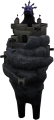
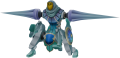
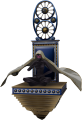
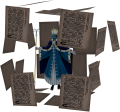
Exclusive to Persona Q: Shadow of the Labyrinth and Persona Q2: New Cinema Labyrinth, FOEs are a type of powerful Shadow that patrol a set path in their designated Labyrinths. Each FOE is represented with a unique overworld model. They are the only type of Shadow to appear in the overworld in the Persona Q duology.
Shadow Types















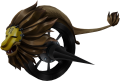
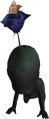
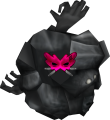




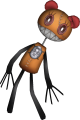



Game Appearances
Persona 2: Innocent Sin
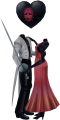
While standard enemy Shadows do not appear, Shadows of the playable party members do appear.
Persona 2: Eternal Punishment
While standard enemy Shadows do not appear, Shadows of the playable party members do appear.
Persona 3
Shadows and Personas are fundamentally the same thing.[3]
Persona 4
In Persona 4, Shadows are beings that appear exclusively in the TV World. There, they are being subconsciously suppressed and do not interact with the real world.[4] Shadows take the form of black blob-like beings that wear a mask associated with an arcana, ranging from I to XII. When fought in battle, they take a more concrete form that takes inspiration from their arcana. By default, Shadows are hostile towards Persona users, but ignore the regular humans who have fallen into the TV. When the fog clears in the TV World, or when humans show a longing for the truth, the Shadows will lash out and attack even normal people.[5][6]
In addition to the smaller black Shadows, humans also have Shadows. After being thrown into the TV World, beings resembling the victims Shadows appear on the Midnight Channel without yellow eyes. Teddie defines this as the TV World resonating with the emotions of the person who was just thrown in. Once inside the TV World, humans can encounter their own Shadows, even if they were not on the Midnight Channel. Similar to the Jungian definition, the Persona 4 Shadows that come from humans are born from a repressed part of that person's heart, but also present alternate possibilities for who they could be.[7] After each member of the Investigation Team accepts their own Shadow, the Shadow transforms into their Persona and becomes a power they can wield in the TV World. These Shadows were meant to kill the originals, and it is unexpected that the Investigation Team were able to turn them into a power they could use.[8]
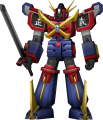
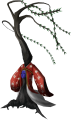
While many Shadow designs in Persona 4 are reused from Persona 3, there are some designs new to Persona 4 which were influenced by people in Inaba. When they tune in to watch the Midnight Channel due to the rumor, their thoughts flow into the TV World, and this influences the appearance of the Shadows that the Investigation Team encounters. For example, the nyogo court lady Shadows, such as the Blossom Nyogo, were influenced by lovers of historical period dramas watching the Midnight Channel.[9] And the robot-looking machine Shadows, such as the Steel Machine, were influenced by mecha anime fans watching the Midnight Channel.[10]
Persona 5
Persona 5 Royal
Persona 5: The Phantom X
According to Lufel, there are two species of Shadow in the Metaverse. The first species consists of monsters born from desire. The individuals that make up the second species are each the embodiment of the hidden side of a human being's psyche.[11]
Nomenclature
| Language | Name | Meaning |
|---|---|---|
 English English
|
Shadow | |
 Japanese Japanese
|
シャドウ Shadō | Shadow |
 Simplified Chinese Simplified Chinese
|
暗影Persona 3 Reload Persona 4 Golden Persona 5 Royal Ànyǐng |
Shadow |
| 阴影Persona 5: The Phantom X Yīnyǐng |
Shadow | |
   Traditional Chinese Traditional Chinese
|
陰影 Yīnyǐng | Shadow |
 French French
|
Ombre | Shadow |
 German German
|
Schatten | Shadow |
 Italian Italian
|
Ombra | Shadow |
 Korean Korean
|
쉐도Persona 3 Persona 3 Portable Swedo |
Shadow |
| 섀도우Persona 4 Persona 4 Golden Syaedou |
Shadow | |
| 섀도Persona 3 Reload Persona 5 Persona 5 Royal Syaedo |
Shadow | |
 Polish Polish
|
Cień | Shadow |
 Brazilian Portuguese Brazilian Portuguese
|
Sombra | Shadow |
 Russian Russian
|
Тень Tenʼ | Shadow |
 Peninsular Spanish Peninsular Spanish
|
Sombra | Shadow |
 Thai Thai
|
ชาโดว์ Chādow̒ | Shadow |
 Turkish Turkish
|
Gölge | Shadow |
Gallery
Persona 4: Dancing All Night
-
 Agitated Shadows
 -
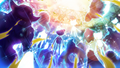 The Shadows Set Free


References
- ↑ "大人になると自分は自分、他人は他人とある程度割り切れるんですけど、少年たちは、自分がどう見られているのかとかをいちばん不安に思うものなので。そういった不安感を漠然と表現しようというのがシャドウのコンセプトでした。" Famitsu Ps2. Published by Enterbrain. Japanese. No. 220 14~15. Cover date September 29, 2006.
- ↑ "タロットカードって1枚の中にもいろいろな要素が描かれているんですが、そのカードの逆位置のイメージ、人間にとっての悪い状態のモチーフを分解して絵にしていくとシャドウになります。" Persona Magazine. No. 4 Page 54. Published February 7, 2012.
- ↑ "シャドウとペルソナは基本的に同じもので、主人公が外界とコンタクトをとるときにどの仮面を選択するのかを葛藤する様を描いています。【副島】" Persona 3: Official Design Works. Published by Enterbrain. Japanese. Page 10.
- ↑ Persona Club P4. p. 188.
- ↑ "Teddie: Well, you need to get your strength back! Then you can tell her! Yuki-chan's normal. The Shadows don't attack normal people. They only attack when the fog lifts here." Persona 4.
- ↑ "Amenosagiri: Still, humans fear what they cannot see. That brief yearning for truth becomes a ray of light which breaks the fog and torments the Shadows...
Yukiko: That's why they attack and kill whoever's nearby at that time... A hollow forest..." Persona 4. - ↑ Persona 4 Golden Premium Fan Book. Japanese. p. 200.
- ↑ "Amenosagiri: The ability to master your Shadow that emerged to kill you, and use its power... A new and uncertain facet of mankind... Is it worthy to put my trust in, or not...? It must be tested..." Persona 4.
- ↑ "Chapter 5: Setting", Persona Club P4, Atlus. Published by Famitsu (2009). Japanese. p. 191. ISBN-13: 475774630X.
- ↑ "Chapter 5: Setting", Persona Club P4, Atlus. Published by Famitsu (2009). Japanese. p. 193. ISBN-13: 475774630X.
- ↑ "Lufel: The Metaverse contains two distinct species of Shadows. The first, enemies that attack with no rhyme or reason. These Shadows are not human, but monsters formed from warped desire. The second, Shadows that are born from the darkness of a human's heart in the real world. A person's true nature concealed within their heart, the embodiment of their desires... To put it differently, another self." Persona 5: The Phantom X.