Astarte

|
This article contains NSFW content. |
| The following imagery depicts content that is sexually explicit and/or graphically violent. Reader discretion is advised. |
| Astarte | |
| アスタルテ | |

Artwork from Giten Megami Tensei: Tokyo Revelation | |
| Origin | Levantine culture |
| Race(s) | Tyrant |
| Alignment(s) | Dark-Chaos Giten Megami Tensei: Tokyo Revelation Giten Megami Tensei: Tokyo Revelation |
Astarte is a Demon in Giten Megami Tensei: Tokyo Revelation.
Profile
Origin
Ashtart[a] or Athtart,[b] known in Greek as Astarte,[c] is a goddess in Levantine polytheism. Her name is the feminine counterpart of the name of Ashtar (also known as Athtar), and it also has an etymological relationship to the name of Ishtar.
Athtar and Athtart may have originally signified the planet Venus in its two roles as the morning star and evening star, respectively.[1][2][3] However, despite the etymological relationship between their names, there is no attested direct evidence of the two deities having any connection.[4] Additionally, the astral characterization is assumed from Athtar and Ishtar, and there is no direct evidence of Athtart being associated with Venus.[5]
In Ugarit, Athtart appears to have been associated with hunting, and she was associated with yet distinct from Anat.[3] She was an important goddess worshiped in Phoenicia in the 1st millennium BC, especially in the cities of Sidon and Byblos.[3]
According to the Bible, Ashtart was a goddess of the Sidonians whom Solomon worshiped,[6][7] and her worship amongst the Israelites is one of the reasons given for the division of Israel after the death of Solomon.[8][7] A place of worship for Ashtart built by Solomon is destroyed by King Josiah of Judah in 2 Kings 23:13.[9][7]
The Masoretic text of the Bible vocalizes her name as עַשְׁתֹּרֶת ʿAštōreṯ (Ashtoreth), which is not the expected form given the attested cognates in other Semitic languages and the Greek spelling Ἀστάρτη Astártē.[10] The majority view, first proposed by Theodor Nöldeke in 1884, is that this is an intentional alteration to resemble the word בֹּשֶׁת bōšeṯ, "shame",[11] though a minority of scholars such as Tsevat (1975) and Cooper (1990) believe that this is unlikely, with the former offering no other explanation for the Masoretic vocalization,[12] and the latter believing that the form is due to regular sound changes in Phoenician occurring before the term entered Hebrew but after it entered Greek.[11]
More often than the singular references, the plural form of Ashtart's name, עַשְׁתָּרוֹת ʿAštārôṯ, was used metonymically in the Bible to refer to goddesses in general. A parallel development can be seen in Assyrian with the word ištarātu (from Ištar).[13]
Design
Astarte's design is essentially a female version of the design of Astaroth from Shin Megami Tensei.
Gameplay
Game Appearances
Giten Megami Tensei: Tokyo Revelation
 This section contains spoilers. (Skip Section)
Astarte is one of the demons that appear after Ayato Katsuragi and his friends fight Murmur the Fallen on Hatsudai Shelter, she specifically eats the heart of Yuuka Tachibana to gain power from it.
Depending on the choices Katsuragi can hear from Sanshiro Soma that Astarte killed Yoshio Nishino at Gokokuji Temple.
She appears as Rui Asuka for the first time at the Yoyogi Labor Camp, she helps Katsuragi and Tetsuya Sonoda to escape from the place.
After Katsuragi is expelled from Pentagramma, she suggests the party to go to Harajuku Shelter since Adonis the Fiend is taking over the place. After defeating him, they go to Shinjuku and hear rumors that people have been disappearing during Full Moons at My City. After learning the truth of the incident, Rui decides to help Kazumi alongside Katsuragi and Sonoda. She helps Mei while Katsuragi and Sonoda help Kazumi.
After helping him overcome his werewolf powers, the party leaves Odakyu HALC, but upon leaving, Katsuragi receives a letter from Adonis, who challenges him to a one-on-one battle at the Shinjuku Ground Zero Colosseum. Upon reaching the place, Rui and Sonoda are told to wait in a room as Katsuragi fights Adonis.
Mysteriously, Rui comes and tells Katsuragi that Sonoda has been killed and his heart has been ripped out. If Katsuragi tries to mourn him, Rui will scold Katsuragi, telling him that he, as someone who only has lived in the shelters, does not know what it is to live in Tokyo, having been protected his whole life and thus not knowing that things such as death happen everyday in Tokyo. After that, they leave the place.
Upon hearing rumors that demons are at Sunshine City at Ikebukuro, Katsuragi and Rui decide to go there, and, upon killing Abaddon the Koutenshi, he leaves a body part of someone, that someone being Yuuka Tachibana. Rui then tells Katsuragi if they get all the body parts they may be able to revive this person, but that she won't participate on this and leaves Katsuragi.
Katsuragi meets with Rui again at Shinagawa Aquarium. She asks Katsuragi if she loves Yuuka or her; depending on what Katsuragi says, the answers will change, but it ends with Rui having a breakdown and running away from the place and, depending on the choices, Katsuragi will have different affinity with her.
Katsuragi meets with Rui again at the Millennium HQ. She tells Katsuragi that she did not wanted to be with him at that time, but that now she wants to accompany him. She will not explain why, but she did not want him to refuse, and depending on the choices, Katsuragi will have different affinity with her.
After venturing through Tokyo with Katsuragi and recovering all the body parts of Katsuragi's friend, she tells Katsuragi that she will leave, but that next time they meet it will be at Bael Castle.
At Bael Castle, Rui will reveal that her true form is that of Astarte the Tyrant and will make Katsuragi choose between her and Yuuka.
Depending on the choice Katsuragi makes here either Astarte or Ishtar the Megami will join depending on how he replies to Rui's question regarding who he loves, if Yuuka or her. Affinity with this characters also affect.
- Route 1: Katsuragi chooses Yuuka and depending on the affinity with Rui different events can happen, in one of them Katsuragi fights her and on the other she rips out her heart from her body and gives it to Katsuragi and so Yuuka transforms into Ishtar the Megami, then at the top floor of Bael Castle they find Murmur the Fallen who after a fight is defeated, and then upon entering the main room they find Baal the Tyrant who after asking Ishtar to be his wife to which she refuses he starts a fight. Upon being defeated, Baal asks Katsuragi to pierce him with his own sword or if he'll be the new King of Tokyo, saying no to either question Baal transforms into a frog and can either die or escape depending on the choices. After that Katsuragi and Ishtar stand upon the ruined city and Katsuragi says that the love between him and Ishtar will be eternal.
- Route 2: Depending on if Katsuragi chose Yuuka or gets betrayed by her and had a Law alignment he instead will be greeted by angels calling him the new Messiah.
- Route 3:If Katsuragi's aligment was Light-Law after doing any route he will grow angelic wings on his back and also be called the new Messiah depending on if he did Route 2.
- Route 4: If Katsuragi chooses Rui, this enrages Ishtar and attacks Katsuragi who after is defeated dies. Upon reaching the top floor of Bael Castle they fight Murmur the Fallen who after a fight is defeated, and then upon entering the main room they find Baal the Tyrant who after asking Astarte where is Ishtar, she responds that she is dead, and now enraged, Baal starts a fight. Upon being defeated, Baal asks Katsuragi to pierce him with his own sword or if he'll be the new King of Tokyo, saying no to either question Baal transforms into a frog and can either die or escape depending on the choices. After this, Katsuragi alongside Astarte stand on a pile of demons, now calling themselves the new rulers of Tokyo.
- Route 5: If Katsuragi chooses Rui and gets any route related to her and route 6 he on the sky will see Ishtar flying to the moon with a sad face, the beautiful Goddess will await for his next time to reincarnate.
- Route 6: If Katsuragi says yes to the questions Baal makes or dies during the fight with him, he will then see everything is now darkness, he sees visions of demons he fought mocking him and then if he decides to struggle he will see a lot of demons praising him as their new King and after that he loses consciousness, and if he chose Rui he will also get Route 5.
- Route 7: If Katsuragi chooses Yuuka and has middle affinity with Rui then she will fuse with Yuuka regardless of who Katsuragi chooses Rui will fuse with Yuuka. Upon reaching Bael Castle's top floor they fight Murmur the Fallen and after defeating they enter the main room and they find Baal the Tyrant. But Ishtar despite having come along obediently to Katsuragi her face changed to one some resembling that of Rui and says how dare he betray her and depending on what Katsuragi says then a fight between Ishtar will begin and after she's defeated Baal will be enraged about losing his wife and so a fight with him begins. After his defeat if Katsuragi had a Chaos alignment he will be seen at the top of countless demons and he will now pronounce himself as the new ruler of Tokyo.
- Route 8: If obtained the requirements for Route 7 but had any other alignment that isn't Chaos he'll get Route 1.
- End of spoilers.
Trivia
- Astaroth is called "Astarte" when shown at the end of Digital Devil Story: Megami Tensei II.
- There are unused remnants of data for a demon "ATHTART" in Shin Megami Tensei V and Shin Megami Tensei V: Vengeance.[14]
Nomenclature
| Language | Name | Meaning |
|---|---|---|
 Japanese Japanese
|
アスタルテ Asutarute | Astarte |
Gallery
-
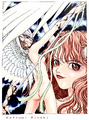 Cover of Gigaten: Giten Megami Tensei: Tokyo Revelation Design Collection featuring Astarte
 -
 Artwork for Giten Megami Tensei: Tokyo Revelation
 -
 Sprite from the PC-98 version of Giten Megami Tensei: Tokyo Revelation
 -
 Attack sprite from the PC-98 version of Giten Megami Tensei: Tokyo Revelation
 -
 Hurt sprite from the PC-98 version of Giten Megami Tensei: Tokyo Revelation
 -
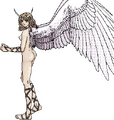 Sprite from the ending of the PC-98 version of Giten Megami Tensei: Tokyo Revelation
 -
 Sprite from the Windows version of Giten Megami Tensei: Tokyo Revelation
 -
 Attack sprite from the Windows version of Giten Megami Tensei: Tokyo Revelation
 -
 Hurt sprite from the Windows version of Giten Megami Tensei: Tokyo Revelation
 -
 Graphic of Astarte in the game over screen of the PC-98 version of Giten Megami Tensei: Tokyo Revelation
 -
 Graphic depicting Astarte eating the body of Yuuka Tachibana from the PC-98 version of Giten Megami Tensei: Tokyo Revelation
 -
 Graphic depicting Astarte eating the body of Yuuka Tachibana from the Windows version of Giten Megami Tensei: Tokyo Revelation


Notes
References
- General
- "Astarte, Ashtoreth", Encyclopedia of the Bible and its Reception (2009), Paolo Merlo. Published by De Gruyter. Vol. 2: Anim – Atheism pp. 1099-1101. ISBN-13: 978-3-11-018370-2. https://doi.org/10.1515/EBR.astarteashtoreth
- "‛Athtart in Late Bronze Age Syrian Texts", Transformation of a Goddess: Ishtar – Astarte – Aphrodite (2014), Mark S. Smith. Published by Academic Press Fribourg. pp. 33-86. ISBN-13: 978-3-7278-1748-9.
- "Astarte in the Bible and her Relation to Asherah", Transformation of a Goddess: Ishtar – Astarte – Aphrodite (2014), Stéphanie Anthonioz. Published by Academic Press Fribourg. pp. 125-139. ISBN-13: 978-3-7278-1748-9.
- Specific
- ↑ The Myth of Cosmic Rebellion: A Study of Its Reflexes in Ugaritic and Biblical Literature (1996), Hugh Rowland Page, Jr.. Published by E. J. Brill. p. 53. ISBN-13: 978-90-04-10563-8. https://doi.org/10.1163/9789004275898
- ↑ Smith 2014, p. 35.
- ↑ 3.0 3.1 3.2 Merlo 2009, p. 1099.
- ↑ Smith 2014, pp. 36-37.
- ↑ Smith 2014, p. 36.
- ↑ 1 Kings 11:5. Retrieved December 17, 2024. Bible Gateway.
- ↑ 7.0 7.1 7.2 Anthonioz 2014, p. 130.
- ↑ 1 Kings 11:33. Retrieved December 17, 2024. Bible Gateway.
- ↑ 2 Kings 23:13. Retrieved December 17, 2024. Bible Gateway.
- ↑ Merlo 2009, p. 1100.
- ↑ 11.0 11.1 "A Note on the Vocalization of עַשְׁתֹּרֶת", Alan Cooper. Zeitschrift für die Alttestamentliche Wissenschaft, 102(1), pp. 98-100. Published 1990 by De Gruyter.
- ↑ "Ishbosheth and Congeners: The Names and Their Study", Matitiahu Tsevat. Hebrew Union College Annual, 46, pp. 71-87. Published 1975 by Hebrew Union College Press.
- ↑ Anthonioz 2014, pp. 126, 132.
- ↑ "MessageLabel": "NotUsed_DEVIL_ID_196_ATHTART", in "Project/Content/L10N/en/Blueprints/Gamedata/BinTable/Camp/Status/DevilProfile.uasset"