
|
This demon page is a stub. You can help Megami Tensei Wiki by expanding it.
|
| No reason provided.
|
Aeshma is a Demon in the Megami Tensei franchise.
Profile

|
This profile section is a stub. You can help Megami Tensei Wiki by expanding it.
|
| No reason provided.
|
Origin
Aeshma is the daeva of wrath in Zoroastrianism and a messenger of Angra Mainyu, the supreme evil of the religion. Ceremonies of faith that were not done correctly were said to be equivalent to performing the ceromony in Aeshma's name. His main enemy is the angel Sraosha, who was created by Ahura Mazda specifically to counter Aeshma's evil, and is prophesied to defeat Aeshma. It is believed that Asmodeus was originally taken from the name Aeshma Daeva and is the Abrahamic reinterpretation of Aeshma.
Design
Aeshma's Shin Megami Tensei IV design is identical to the design of Asmodeus by guest artist Yasushi Nirasawa, with the only difference being with colour. Rather than the bone armour being red, it is white with his eyes glowing blue rather than green.
Gameplay
Compendium
| Compendium Entries
|
| Shin Megami Tensei IV
|
An evil god of Zoroastrianism, whose name means "wrath."
A demon of wrath and rage, he is said to stir up anger and feelings of vengeance in humans. Those who fall under his spell become violent, and according to Zoroastrian belief, those who become uncontrollable when drunk are said to be under the spell of Aeshma. Opposing Aeshma are Ahura Mazda and Sraosha; he is fated to lose to Sraosha in the end. It is believed that the demon Asmodeus, who appears in the Book of Tobit, is derived from Aeshma.
|
| Persona 2: Innocent Sin
|
Zoroastrian demon of rage who lures men to violence through inebriation.
|
| Persona 2: Eternal Punishment
|
Zoroastrian demon of frenzy who leads people to violence.
|
Trivia
Nomenclature
Gallery
-
-
Sprite from Shin Megami Tensei IV
-
-
-
Sprite of Reverse Aeshma from Persona 2: Innocent Sin
-
-
Card graphic from Persona 2: Innocent Sin
-
Card graphic from Persona 2: Eternal Punishment
References
- ↑ Page description: A table of bosses and where they would be encountered. MegaTen Maniacs (2017), Nobuyuki Shioda and Masashi Uchida. Japanese. p. 133.

 Shin Megami Tensei IV


 English
 Japanese
 Korean
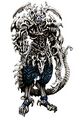 Artwork from Shin Megami Tensei IV
 Sprite from Shin Megami Tensei IV
 Sprite from Ronde
 Sprite from Persona 2: Innocent Sin
 Sprite of Reverse Aeshma from Persona 2: Innocent Sin
 Sprite from Persona 2: Eternal Punishment
 Card graphic from Persona 2: Innocent Sin
 Card graphic from Persona 2: Eternal Punishment


